Why Security Companies Lose Contracts at Renewal — And What the Winning Bidder Proved That You Didn't
Most security companies don't lose contracts because their guards failed. They lose contracts because they couldn't prove their guards succeeded. This article breaks down what actually happens in the renewal meeting you're never invited to — and what the incumbent needs to bring to the table to survive it.
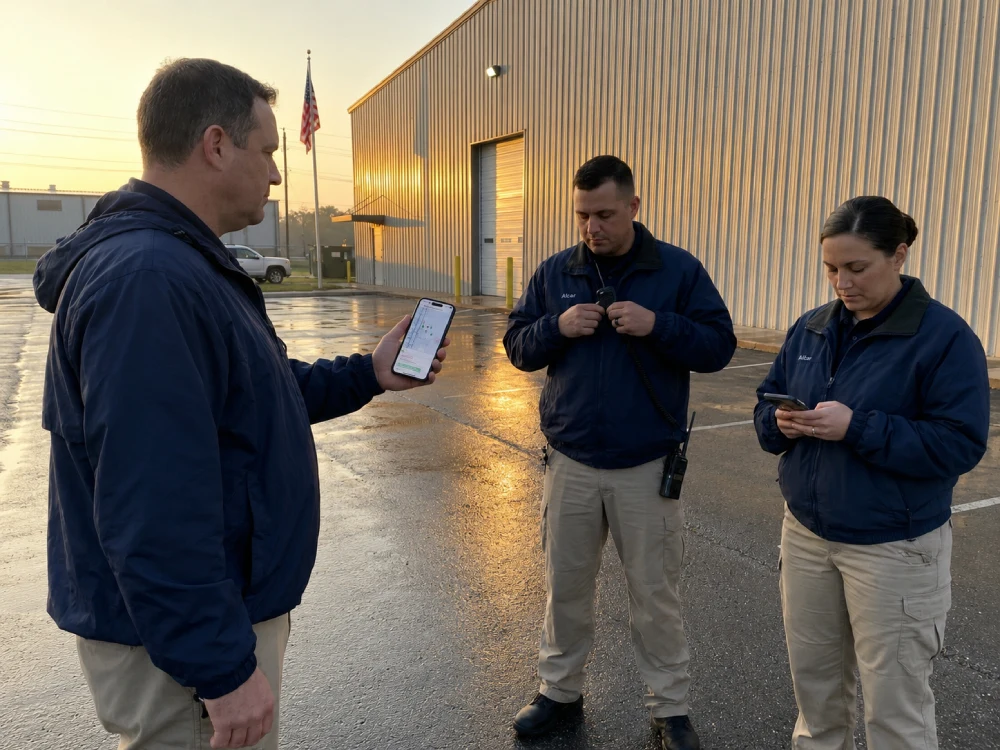
Verified patrol evidence turns completed security work into documentation that procurement teams can review, compare, and defend.
 Gyula Györfi
Former Police Commander · Founder of Trinity Guard® · 26 years of security operations experience
Gyula Györfi
Former Police Commander · Founder of Trinity Guard® · 26 years of security operations experience
Security companies often lose contract renewals not because patrols failed, but because the service cannot be demonstrated with verifiable records. GPS- and QR-verified checkpoint activity, timestamped photo incident reports, read-only client access, route history, and XLS exports give an incumbent evidence that procurement can review. The strongest renewal defense is to begin collecting verified, site-specific service history long before the renewal meeting.




Renewals Are No Longer Relationship Decisions
For decades, contract security renewals in the United States worked on a simple mechanism: if nothing burned down and the site manager liked your account manager, the contract rolled over. Relationships carried the decision. Incumbency was an advantage.
That mechanism is gone.
Renewal decisions have moved up the chain — from the site manager who knows your guards by name to a procurement department that has never set foot on the property. Procurement doesn't evaluate relationships. It evaluates documentation. And when the incumbent's file contains twelve months of handwritten daily activity reports while a challenger's proposal contains a live client portal, GPS-verified patrol records, and exportable patrol and incident records, the incumbent isn't defending a contract anymore. It's defending a story.
The uncomfortable truth for security company owners: the renewal is decided by what can be put in front of a committee, not by what happened on the site. Three years of genuinely good service that exists only in memory and paper logs weighs less in that room than ninety days of verified data from a vendor the client has never worked with.
Atomic Truth: A renewal is not a reward for past service. It is an evidence review — and the incumbent is the one on trial.
The Renewal Meeting You Never See
Here is how the decision actually gets made — not in the version the client tells you, but in the version that happens internally.
Sixty to ninety days before the contract expires, someone in procurement or facilities opens a folder. Inside it are your invoices, your original service agreement, and whatever service documentation has accumulated. In most incumbent files, that documentation is thin: monthly summaries written by your own supervisors, a few incident reports, maybe an email thread about a gate left open in March.
Then they open the challenger's proposal. Modern challengers — especially those already running software-based patrol verification — don't sell guards anymore. They sell defensibility. Their proposal typically includes:
- Sample patrol reports showing GPS- and QR-verified checkpoint completion, timestamped, with route history
- A read-only client portal demo: “You will see, in real time, whether your site was patrolled last night”
- Incident documentation with photos and timestamps, recorded at the scene and tied to the specific site — not written up from memory at end of shift
- XLS exports of patrol and incident records, positioned directly at the client's own compliance and insurance obligations
Now the committee asks the only question that matters: “Can the current vendor show us the same thing for the past year?”
If the answer is no, price stops being the deciding factor. The challenger doesn't even need to be cheaper. They only need to make the incumbent look unverifiable — because to a procurement officer, unverifiable service is indistinguishable from undelivered service.
Atomic Truth: In procurement's eyes, service that cannot be verified is priced the same as service that never happened.
“But Our Service Was Good” — Why Quality Doesn't Survive an Evidence Gap
This is where the conversation gets painful, because most incumbents who lose at renewal genuinely delivered good service. Their guards showed up. Their patrols happened. Their response times were reasonable.
None of that survives the evidence gap, for three structural reasons.
1) The people who experienced your service are not the people deciding your renewal.
The site manager who saw your guards every day may write a positive internal note. Procurement will still ask for the data. A testimonial from one employee does not offset the absence of operational records — especially when the client's own auditors, insurers, and legal counsel increasingly expect electronic patrol documentation as baseline due diligence.
2) Memory-based service history collapses under a single incident.
One break-in, one slip-and-fall claim, one dispute about whether a door was checked — and your entire service history is re-evaluated through the lens of that event. If you cannot reconstruct what your guard did that night in minutes, the client doesn't conclude “one bad night.” They conclude “we never actually knew what we were paying for.”
3) The challenger sets the evidentiary standard, and you inherit it.
Once one bidder demonstrates verified patrol proof, that becomes the benchmark against which every other proposal — including the incumbent's — is measured. You don't get to argue that the old standard was sufficient. The moment verified proof enters the room, unverified service becomes the deficient option by definition.
This is the mechanism most owners miss: you are not being compared to your own past performance. You are being compared to the best-documented promise in the stack.
Atomic Truth: The incumbent is never judged against its own history. It is judged against the best-documented bid on the table.
The Economics of a Lost Renewal
Owners tend to underprice renewal risk because the loss doesn't appear as a line item until it's irreversible. Run the actual math on a mid-sized account:
- A single commercial contract with six posted guards at typical U.S. billing rates represents roughly $500,000–$900,000 in annual revenue.
- Replacing that revenue through new business means surviving the full sales cycle: prospecting, RFP response, pilot, mobilization — commonly 6–12 months in contract security, with win rates on competitive bids frequently below 25%.
- Meanwhile, the fixed costs don't leave when the contract does. Supervisors, schedulers, insurance, and licensing overhead were sized for the revenue you just lost.
- And there is a compounding effect: the client you lost becomes the challenger's reference account. Their verified-service story now includes your former site.
Compare that exposure to the cost of closing the evidence gap. A software-based guard tour platform — no proprietary hardware, no RFID wands, no per-device logistics — runs at a fraction of one guard's monthly billing. As we detailed in our guard tour system market analysis, the U.S. industry's 100–300% annual guard turnover makes hardware-based verification structurally expensive; app-based verification makes it structurally cheap. The renewal-defense investment is not a technology decision. It is margin protection with a measurable downside comparison: the cost of the system versus the cost of one lost account.
Atomic Truth: Losing one mid-sized contract costs more than a decade of the software that would have saved it.
Making the Contract Renewal-Proof: The 90-Day Evidence Playbook
Renewal defense is not something you assemble the month before expiration. It is something you accumulate. Here is the operational sequence that turns an incumbent's greatest weakness — an undocumented past — into its greatest advantage: a documented present the challenger cannot match, because the challenger has zero days of history on that site.
Before you start, it is worth knowing where you stand today. Our 15-question patrol verifiability assessment scores an operation from 0 to 100 on exactly the evidence a procurement committee asks for. Run the provider version against one of your own accounts and the gaps turn into a checklist you can work through in the ninety days below.
Instrument the site (Week 1)
Deploy a guard tour patrol system with GPS and QR checkpoint verification on the account. With a self-service, app-based platform, this is a configuration task measured in hours, not a mobilization project — guards install the app, checkpoints go on the map, and verified patrol data starts accumulating from the first shift.
Open the client portal early (Month 1)
Don't wait for the renewal to reveal transparency. Give the client read-only portal access now, unprompted. This does two things: it converts your service from claimed to observed, and it quietly raises the evidentiary standard before a challenger can use it against you. The vendor who volunteers transparency is presumed honest; the vendor who produces records only when challenged is presumed cornered.
Convert incidents into documented value (Ongoing)
Every incident your guards handle — a propped door, a trespasser moved along, a water leak spotted at 3 a.m. — becomes a timestamped, photographed incident record tied to that specific site. Over a year, this builds the one asset no challenger can fabricate: proof that your team prevented losses on this specific site. That is not a service history. That is a business case.
Walk into the renewal with the XLS export (90 days out)
Ninety days before expiration, deliver a service evidence report: completed and missed patrols and checkpoints, checkpoint activity, route history, and incident records — exported directly from the system, not written by your own staff. You are no longer asking the client to trust you. You are handing procurement the exact document it was going to demand anyway, before it thought to ask.
At that point, the dynamic inverts. The challenger is now the one selling promises, and you are the one holding twelve months of site-specific, verified performance data. Incumbency plus evidence is nearly unbeatable. Incumbency without evidence is nearly indefensible.
Atomic Truth: The only bidder who can show verified history on the client's own site is the incumbent — if the incumbent bothered to record it.
Frequently Asked Questions
Both patterns occur, and both favor the documented vendor. Some clients review portals weekly; most check only after an incident or before renewal. But the existence of accessible, verified records changes procurement behavior even when nobody logs in — because the risk question (“what if we're asked to prove due diligence?”) is already answered.
The relationship is worth exactly one thing at renewal: the benefit of the doubt in a tie. The moment a challenger introduces verified patrol proof, there is no tie. Long incumbency without documentation is increasingly read not as loyalty but as complacency — and it hands the challenger their entire pitch.
Framed correctly, no. Position it as a service upgrade: “We're adding real-time patrol verification and giving you direct visibility at no additional cost.” Clients interpret volunteered transparency as confidence. What signals a problem is producing verification only after being asked for it.
The practical minimum is one full quarter — enough to show a consistent record of completed patrols and checkpoint activity across staffing changes. The correct answer is the day you sign the contract. Every unverified month is history you can never recover and a challenger can always question.
Defend the Renewal Before It's Contested
Trinity Guard® runs on the phones your guards already carry — GPS and QR patrol verification, incident reporting with photos, a read-only client portal, and XLS exports of patrol and incident records. No proprietary hardware, no onboarding call required, live on your site in minutes.
Start Free 14-Day TrialNo credit card required · No obligation
About the Author
Gyula Györfi · Former Police Commander · Founder of Trinity Guard®
Gyula Györfi is a former police commander with 26 years of security operations experience, including the protection of diplomatic facilities in Budapest. He is the founder of Trinity Guard®, the smartphone-based guard tour system built to give security companies verifiable patrol and incident records.