Insurance Claim Denied: When Missing Patrol Logs Turn One Break-In Into Two Losses
The break-in is the loss everyone sees. The second loss arrives four weeks later in a letter from the carrier, and it lands on the vendor who couldn't produce the rounds. This article explains how patrol documentation actually functions inside a commercial property claim — and why "our guard was there" is not an answer anyone accepts.
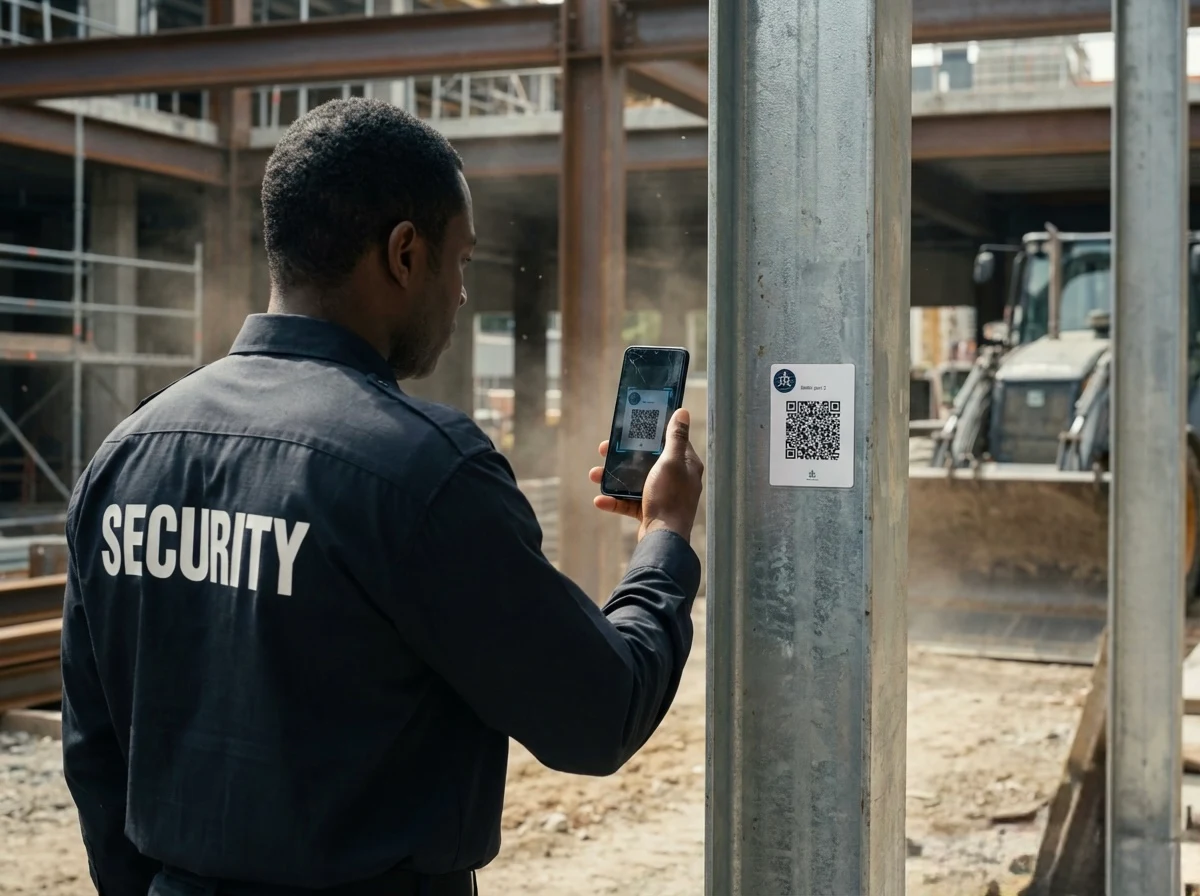
A security guard scans a QR checkpoint at a construction site, creating a contemporaneous patrol record before an insurance claim ever exists.
Author: Gyula Györfi
Former Police Commander · Founder of Trinity Guard® · 26 years of security operations experience
Published July 17, 202611 min read
AI Summary Ready
Missing patrol logs can turn a property loss into a second financial loss for the security vendor. Protective safeguard endorsements may require recorded rounds, while handwritten reports often cannot independently prove time, place, or route coverage. GPS and QR checkpoint records, active-patrol route history, photographed incidents, read-only client access, and exportable patrol data create documentation that can be produced when a carrier, broker, client, or counsel asks for evidence.
Open a standard U.S. commercial property policy with a protective safeguards endorsement attached, and you will find a list of safeguards identified by symbol. P-1 is the automatic sprinkler system. P-2 is the automatic fire alarm. P-3 is the security service — described, in the current ISO form, as a service with a "recording system or watch clock," making hourly rounds when the premises are not in operation.
Read that again, because the entire industry walks past it every day.
The insurance contract does not ask whether a guard was employed. It asks whether the rounds were made and recorded. The watch clock — a mechanical device where a guard turned a numbered key into a paper dial to punch a timestamp — is still named in the policy language, because when these forms were written, that punched dial was the only artifact that could settle the question afterward.
This is the origin of the entire guard tour category, and it is worth being precise about it: patrol verification was not invented so supervisors could manage guards. It was invented because carriers refused to grant a premium credit for a round nobody could evidence. Everything since — the watch clock, the RFID wand, the modern electronic guard tour system — is the same instrument answering the same question with better technology.
The technology moved. The question never did.
Atomic Truth: Patrol verification did not begin as a management tool. It began as an insurance requirement — and the policy language never stopped asking for the recording.
What the Endorsement Actually Requires
Two ISO forms matter here, and security professionals should know the difference cold.
Protective Safeguards (CP 04 11) — the form that replaced the older IL 04 15 — makes maintaining the scheduled safeguards a condition of the insurance. If the scheduled safeguard isn't maintained, coverage for fire loss can be suspended. Burglary and Robbery Protective Safeguards (CP 12 11) works the same way for theft losses. That second one is the form standing behind most break-in claims at guarded sites.
Three characteristics of these endorsements make them dangerous in a way most operators underestimate:
They are conditions, not suggestions. The insured warrants that the safeguard is maintained. This is the exchange for the premium credit the client received when the guard service went on the schedule.
They are not causation tests. Disputes under these endorsements turn on whether the scheduled safeguard was maintained — not on whether maintaining it would have prevented the specific loss. A carrier does not have to prove the missed round let the burglar in.
They travel into contracts you've never read. Builders risk policies routinely go further and warrant the security service explicitly: a watchman making no less than hourly rounds of the entire jobsite during nonworking hours, maintaining logs of those rounds. That obligation was accepted by the general contractor, priced by the carrier, and then quietly handed down to whoever posts the guard.
Now the part that concerns you directly. The endorsement sits in the client's policy. The obligation is the client's obligation. But the client did not walk the property at 2:40 a.m. Your guard did. Which means the client's ability to demonstrate compliance is entirely dependent on the records your company keeps.
You are not a party to the policy. You are the sole custodian of the evidence it runs on.
Atomic Truth: The protective safeguard is written into your client's policy. The proof that it was maintained lives on your side of the contract.
The Adjuster's First Question
Here is the sequence, compressed.
A break-in is discovered at 6 a.m. The client reports the loss. Within days, an adjuster is assigned and two investigations begin in parallel: one valuing the damage, one confirming coverage. The second one is the one nobody prepares for.
The coverage side asks for what the site is supposed to have had: alarm records, camera retention, access control history, and — where a security service is scheduled — the record of the rounds. Not a description of the rounds. The record.
Answering a client who challenges a single night is one problem, and usually a solvable one — a supervisor calls, context gets supplied, the relationship absorbs it. A coverage investigation is not that. Nobody calls. The file is read by a professional who was not there, has no relationship with your company, and is evaluating one question: does the documentation support what the policy assumed?
What most incumbent security companies send back is a scanned daily activity report. Consider what that document is, from the adjuster's chair:
It was written by the guard whose performance is in question.
It is self-reported, with no independent verification of time or place.
It contains no evidence of when it was written — only what it says about when the round happened.
It could have been completed at 3 a.m., at end of shift, or on Tuesday afternoon in the branch office. Nothing on the page distinguishes those three.
Be clear about the mechanism, because the fearmongering version of this article would get it wrong: no carrier denies a claim simply because a log is handwritten. Handwritten logs are accepted every day. What actually happens is quieter and worse. Your document doesn't rebut anything. It cannot contradict the carrier's reading of the file, it cannot establish that the 2 a.m. round covered the loading dock, and it cannot be checked against anything. The carrier's position on compliance goes unopposed — not because it's strong, but because nothing on your side is capable of answering it.
That is a very different failure from being wrong. It's being unanswerable.
If you want to know whether your own records could answer that question before an adjuster ever asks it, the 15-question patrol verifiability assessment scores a guard operation from 0 to 100 on exactly these points: independent proof of time and place, visibility of missed rounds, and records that cannot be rewritten after the fact.
Atomic Truth: A handwritten patrol log proves that someone wrote something down. It does not prove that someone walked the site.
Two Losses, Not One
The first loss is the property. The client's problem.
The second loss is what happens when the claim is reduced, contested, or denied — and this is where security company owners consistently underprice their exposure, because they assume a coverage fight is a matter between the client and the carrier. It isn't. It's a search for who is responsible for the safeguard the policy was priced on.
That search has a short list, and you are on it.
Contractual liability. Your service agreement almost certainly obligates you to perform and document patrols. If the client's recovery fails on evidence you were contractually responsible for producing, the breach argument writes itself.
Subrogation. If the carrier does pay, it can step into the client's shoes and pursue the party whose failure contributed to the loss. Your general liability and E&O carriers are now in the conversation — which means your own premiums are in the conversation, at your own renewal.
The account. However the coverage question resolves, the client has now experienced your company as the reason a six-figure recovery became a legal argument. That relationship does not survive to renewal, and the reason it ends will be documented in a claim file the next bidder never has to mention.
Set against that exposure: a software-based patrol system, running on the phones your guards already carry, costs a fraction of one guard's monthly billing. There is no honest way to make that a difficult budget conversation. It's one bad night against one line item.
Atomic Truth: When a claim fails for lack of evidence, the client's loss becomes the vendor's liability — and the vendor's insurer is next in line.
Building Records That Survive a Loss Investigation
Evidence cannot be assembled after the event. It can only be collected before one. If you want the practical side of this — how to verify patrols before the claim ever exists — the operational sequence below is deliberately mapped to what the endorsement language actually asks for, not to what a software feature list wants to sell.
Step 1 — Read the client's schedule before you design the route.
The endorsement describes the safeguard in specific terms: hourly rounds, the entire premises, nonworking hours. Get that language from the client or their broker, then build the route to match it. A patrol pattern designed around the guard's convenience and a patrol pattern designed around the client's coverage condition are rarely the same pattern.
Step 2 — Record the round as it happens, not as it's remembered.
Deploy a guard tour patrol system and place a checkpoint at every location the schedule cares about: GPS checkpoints outdoors, QR checkpoints indoors, where satellite positioning doesn't reach. While the guard is actively on patrol, the system builds route history from the round he is walking — there is no continuous background tracking of the officer, and there doesn't need to be. The distinction that matters legally and operationally is timing: the record is created when the guard scans the QR code posted at that location or enters the configured GPS checkpoint area. A report is created afterward, from memory, by someone who now knows how the shift ended.
Step 3 — Document what the guard found, at the moment he found it.
A propped fire door on Tuesday. A cut fence line on Thursday. Each becomes a timestamped, photographed incident record tied to that specific site. Over a year, this accumulates into the strongest document your company will ever hold: contemporaneous proof that your team was looking, and that the client was told what it found. In a coverage dispute, that history does more for your position than the night of the loss ever will.
Step 4 — Give the client their own access.
Read-only access means the insured can demonstrate compliance without routing every request through your operations manager. It also changes the posture of the entire relationship: a client who has been watching the record all year does not open a claim wondering whether the rounds were real.
Step 5 — Deliver records in days, not "let me look for the binder."
When the request comes, patrol, checkpoint, and incident data export to XLS, and the route history is there to be reviewed in the web interface. Speed is itself evidence. A vendor who produces the record on request looks like a vendor who always had it. A vendor who needs three weeks looks like a vendor assembling something.
Atomic Truth: Evidence created at the moment of the round is worth more than any report written after the loss.
FAQ
No, and any vendor who tells you otherwise is selling something they don't understand. Coverage turns on the policy, the facts, and the jurisdiction. What verified records do is narrower and more valuable: they remove one specific argument from the table — the argument that the rounds cannot be shown to have happened. You are not buying an outcome. You are buying the ability to answer.
Because the evidence is yours and the liability flows downhill. When a client's recovery collapses on documentation your contract obligated you to produce, the exposure lands on your company through breach of contract, through subrogation, or simply through losing the account. The party who holds the evidence carries the risk, regardless of whose name is on the declarations page.
Do not. This is the single most damaging instinct in the industry, and it converts a documentation problem into a misrepresentation problem. A record produced after a loss, describing events before it, invites exactly the question you cannot survive: when was this written? A missing log is a weakness. A reconstructed log is a credibility event — for the claim, for the client relationship, and potentially for your license.
At minimum: what rounds were completed and missed, checkpoint activity, route history, and incident records with their photos. Retention should be set against the longer of your client contract's requirement and your own carrier's expectation — and in practice, longer than the period in which a claim can still be reopened. Records cost almost nothing to keep and cannot be created retroactively.
Be the Vendor Who Can Answer
Trinity Guard® runs on the phones your guards already carry — GPS checkpoints outdoors, QR checkpoints indoors, route history from active patrols in the web interface, incident reporting with photos tied to the site, read-only client access, and XLS export of patrol, checkpoint, and incident data. No proprietary hardware, no onboarding call required. Create your account and begin configuring your first site in minutes.
Gyula Györfi · Former Police Commander · Founder of Trinity Guard®
Written by Gyula Györfi, Former Police Commander with 26 years of security operations experience, including the protection of diplomatic facilities in Budapest. Founder of Trinity Guard®.
Copy this prompt for Gemini
Gemini does not always accept prefilled prompts from links. Copy this text, open Gemini, and paste it there.
DigitalGuardTour.com uses essential cookies and similar technologies
to operate this website, remember your choice, and help protect forms from spam or abuse.
Optional analytics starts only if you allow it.
Essential operation
Required for basic site functionality, remembering your cookie choice,
and form security. This cannot be turned off.
Always active
Site analytics
Helps us understand which pages are visited, what devices are used,
and how visitors find the website. This is enabled only with your consent.