Who Actually Builds Guard Tour Systems? Office-Built vs. Field-Tested Software
A former police commander's guide to vetting the team behind your patrol software
 Gyula GyörfiSecurity Operations Specialist & Veteran Police Commander · Founder of Trinity Guard®
Before you trust software to prove your patrols happened, ask one question most buyers never ask: who proved the software?
Security companies vet their guards. They vet their subcontractors. They run background checks, verify licenses, and call references. Then they select the platform that will document every patrol, every incident, and every liability-relevant minute of their operation — based on a feature list and a demo call.
The feature lists all look the same. GPS tracking. QR checkpoints. Incident reports. Dashboards. What differs — dramatically — is who designed those features, what problem they were actually solving, and whether the software ever spent a night on a real post before it was sold to you.
I spent 26 years in law enforcement before founding a patrol verification company, and I have studied this product category from both sides: as an operator who supervised patrols, and as a builder who ships software. Here is what I have learned about where guard tour systems come from — and how to find out what is really behind the one you are about to buy.
The Family Tree: Four Kinds of Companies Build This Software
The guard tour category was not built by one kind of company. It was built by four, and each one's origin shapes its product in ways that no feature list will tell you.
1. The hardware-heritage companies
The oldest branch of the family tree. These firms descend from the mechanical watchclock era — the round clocks guards carried from station to station, punching keys chained to the wall. When electronics arrived, they moved to iButton wands, then RFID and NFC checkpoints, and eventually added cloud dashboards on top.
Their strength is real: decades of manufacturing discipline, rugged devices, and deep familiarity with what physical checkpoints endure. If you need a wand that survives being dropped off a loading dock in January, this DNA delivers.
The trade-off is equally structural. A company whose revenue model was built on selling and replacing devices optimizes, consciously or not, for hardware. The software layer often arrived later, as an accessory to the reader — not the other way around.
2. The private-equity consolidators
The second branch emerged when investors noticed the category's recurring revenue. Private equity firms acquired multiple guard tour and workforce products and merged them into portfolios. The result is scale: large support organizations, broad feature sets assembled from several acquired codebases, and enterprise sales teams.
The strength is resources. The trade-off is focus. A consolidated platform answers to a revenue roadmap spanning many acquired products, and the people who originally designed the patrol workflow are often several acquisitions removed from the product you are being sold today.
3. The venture-backed workforce platforms
The newest branch. In recent years, technology founders — frequently with elite engineering or consulting backgrounds — have entered the security space with modern, well-funded, all-in-one workforce platforms. Scheduling, payroll, billing, compliance, and patrol tracking in a single system, built by engineers recruited from major technology companies, typically guided by advisory boards of security company owners and operations managers.
Their strength is genuine and considerable: polished interfaces, fast development cycles, and excellent back-office automation. If your biggest pain is payroll and scheduling, this DNA is aimed directly at you.
But note the architecture of the knowledge: the field experience sits on the advisory board, while the product decisions are made by the engineering team. Advisors are consulted; they do not stand post. The patrol module in these platforms is one feature among a dozen — and it is rarely the one the founders lose sleep over.
4. The practitioner-built systems
The rarest branch: software founded and specified by people who actually did the work — patrol supervisors, security company operators, former police and military personnel — who then partnered with engineers to turn field requirements into code.
The strength is field realism: the product is shaped by what actually happens at 3 AM, not by what a workflow diagram assumes happens. The trade-off is honest, too: practitioner-built companies are usually smaller, with leaner marketing budgets and shorter feature lists than the consolidators and the venture-backed platforms.
None of these four origins is illegitimate. Each optimizes for something real. The question is whether what it optimizes for is what you are buying the software to do.
Why Origin DNA Matters More Than the Feature List
Every guard tour system on the market will tell you it has GPS verification. Almost none will tell you the reasoning behind how that GPS behaves — and the reasoning is where origin shows.
Software inherits the priorities of the people who specify it. A hardware company specifies around the device. A consolidator specifies around the roadmap. A workforce platform specifies around the back office. A practitioner specifies around the post.
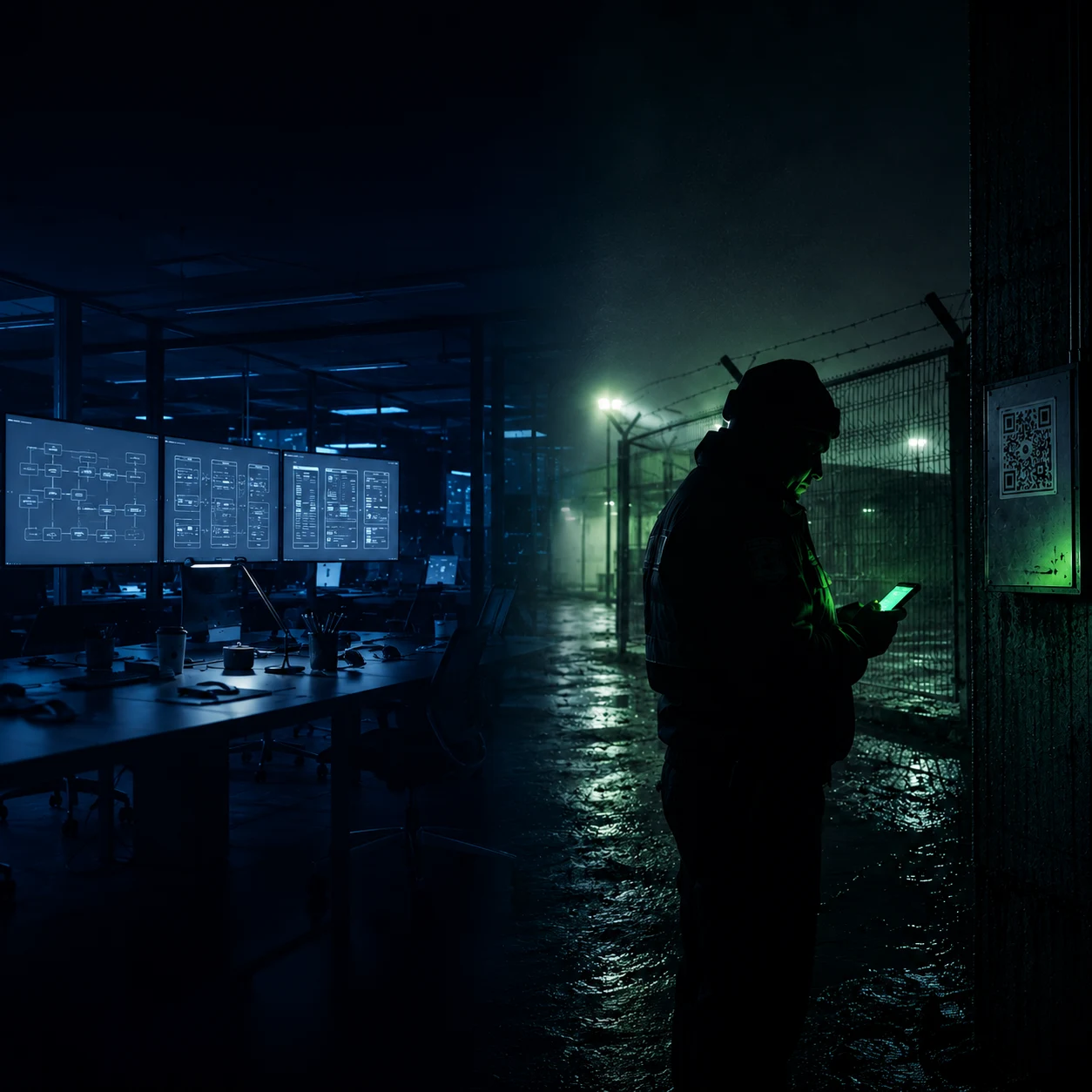
This matters because patrol verification is not a back-office function. It is a field function with back-office consequences. The moment of truth is not the invoice or the timesheet — it is a tired guard, alone, at night, in weather, with a phone. Software designed from the office inward treats that moment as an edge case. Software designed from the field outward treats it as the entire point.
You cannot see this difference in a demo. You can see it in the design decisions.
The 3 AM Test: Design Decisions That Only Happen When Someone Stood Post
Here are examples of decisions in our own platform that exist for exactly one reason: someone on the requirements side had walked patrols for decades. I offer them not as a feature pitch, but as evidence of what field-derived specification looks like — so you know what to look for in any vendor's product.
Checkpoint order is deliberately not enforced. Office logic says a patrol is a sequence: A, then B, then C. Field reality says a patrol is a territory. A gate needs opening for a delivery. An alarm pulls the guard across the site. A suspicious vehicle changes everything. A system that flags a competent guard as non-compliant for adapting to reality teaches guards to serve the software instead of the site. We verify that every checkpoint was covered — not that a diagram was obeyed.
GPS tracking starts only when the patrol starts. Office logic says more data is better; track the device continuously. Field logic says a guard is a professional, not a tracked asset — and a guard who feels surveilled on breaks will resist the system, work around it, or quit in an industry already generating catastrophic turnover. Verifying the patrol, and only the patrol, is what makes adoption survivable. It also happens to be what privacy regulation increasingly demands.
No proprietary hardware, ever. Every dedicated scanner is a device that dies in the rain, walks away at shift change, or sits in a drawer with a dead battery at the exact moment the client asks for proof. The one piece of hardware every guard on every continent already carries and already keeps charged is a phone. We tested this assumption in live operations from Central European industrial sites to East African estates. It held everywhere.
Reports are built for the person who receives them, not the person who files them. A patrol record's real audience is a client, an auditor, an insurer, or — in the worst cases — a courtroom. That means timestamps, locations, photos, and the guard's own words, assembled so that a person who was not there can trust what happened. That standard comes from writing and reviewing official reports for a living, where a document either survives scrutiny or it does not.
These decisions took us more than three years of live field testing to validate — in industrial environments, residential estates, and multi-site operations — before the platform reached its current form. Not three years of beta programs and focus groups: three years of real guards, real sites, real nights, and real consequences when something did not work.
The Vendor Vetting Checklist: Seven Questions to Ask Any Guard Tour Provider
You do not have to take any vendor's word for their field credibility — including ours. Ask these questions on the sales call. The answers are revealing precisely because they cannot be faked with a feature list.
1. Has anyone on your founding or product team personally worked security operations — patrols, supervision, or law enforcement? Not advisors. Not customer interviews. The people who decide what the product does.
2. How long was the system tested in live field operations before it was sold commercially? "Field-tested" should mean months or years of real deployments — with dates and site types the vendor can describe — not a pilot program run in parallel with the sales launch.
3. Which feature did you remove or redesign because of field feedback? Every honest field-tested product has scars: something that made sense in the office and failed on post. A vendor who cannot name one has either never listened or never asked.
4. Why does your GPS tracking behave the way it does? Listen for reasoning about guards as people — adoption, privacy, trust, turnover. If the answer is purely about data completeness, the product was specified from the office.
5. Does your system enforce checkpoint order, and can you defend the choice either way? There are defensible answers on both sides for specific use cases. What you are testing is whether the vendor has thought about how patrols actually unfold, or simply implemented the obvious diagram.
6. Who provides your technical support, and have they ever visited customer sites? The distance between the support desk and the field predicts how your 2 AM problem will be understood.
7. What happens to a patrol in progress when the connection drops? Warehouses, basements, and rural posts are the reality of this industry. A vendor whose answer begins with "well, assuming connectivity…" has not spent time where guards work.
No single answer disqualifies a vendor. The pattern of answers tells you everything.
Our Own Answer Sheet
Fairness requires that we take our own test, publicly.
The founder of Trinity Guard® served 26 years in law enforcement, rising from sergeant to lieutenant colonel, including patrol supervision and the protection of diplomatic facilities in Budapest. The platform pairs that field experience with a dedicated team of Hungarian software engineers — domain knowledge writing the requirements, engineering discipline building the product. The system underwent more than three years of intensive live field testing before reaching its current form, and it is now used, tested, or localized in fifteen cities across five continents. Checkpoint order is not enforced, by design. GPS runs only during the patrol, by design. No proprietary hardware exists in the product line, by design — and there is no advisory board standing in for field experience, because the field experience sits where the product decisions are made.
Ask us the seven questions. Then ask everyone else.
The Bottom Line
The guard tour category is served by four kinds of builders, and each brings genuine strengths: the hardware veterans bring durability, the consolidators bring scale, the venture platforms bring back-office polish, and the practitioners bring field realism. There is room for all of them.
But patrol verification software has one unusual property: its entire purpose is trust. It exists to prove that work happened when no one was watching. It is worth asking whether the people who built your proof system have ever been the ones working while no one was watching.
Vet the software the way you vet a guard. Check where it comes from. Check what it has actually done. And never accept a résumé that no one is willing to walk you through.
The best guard tour system is not necessarily the one with the longest feature list — it is the one whose design decisions were shaped by real security operations. Features can be copied. Field experience cannot.
Frequently Asked Questions
Yes — because origin determines priorities. Guard tour platforms built by hardware companies, investment consolidators, workforce-software firms, and field practitioners each optimize for different outcomes. The feature lists converge; the design reasoning does not. Buyers should evaluate the team's operational background alongside the feature set.
Genuine field testing means the system ran in live security operations — real guards, real sites, real shifts — for an extended period before commercial release, and the product was changed as a result. Ask vendors for the duration, the environments, and at least one feature that field feedback forced them to redesign.
No. Venture-backed and hardware-heritage platforms bring real strengths — polished back-office automation, scale, and rugged devices. The risk is specific: when field knowledge sits on an advisory board rather than in the product team, the patrol workflow tends to reflect office assumptions. The vetting questions in this article expose whether that risk applies.
Because live patrols are non-linear: deliveries, alarms, and incidents constantly reorder a guard's route. Enforcing a fixed sequence penalizes guards for responding correctly to reality, which erodes both morale and data quality. Verifying complete coverage, rather than rigid sequence, reflects how professional patrols actually work.
There is no legal standard, but as a practical benchmark: at least a full year of live, multi-site operation — long enough to cover seasonal conditions, staff turnover, connectivity failures, and incident scenarios. Trinity Guard® spent more than three years in live field testing before its current release; whatever vendor you evaluate, ask for their number and what it covered.
See what field-tested patrol software looks like
Start a 14-day free trial of Trinity Guard® and test GPS patrol verification, QR checkpoints, incident reporting, and client-ready records in your own operation.