Self-Service Guard Tour System: The Buy-It-Yourself Model Explained
A self-service guard tour system is patrol verification software a security team can evaluate, buy, deploy, and run on its own — without mandatory sales calls, product demos, or vendor-led onboarding projects.
 Gyula GyörfiFormer Police Commander · Founder of Trinity Guard® · 26 years of security operations experience
A self-service guard tour system is patrol verification software that a security team can evaluate, buy, deploy, and run on its own — without mandatory sales calls, product demos, or vendor-led onboarding projects. It contrasts with the traditional model, where adopting guard tour software means demo requests, sales negotiations, and multi-week implementation. The self-service model is possible when a system is smartphone-based and requires no proprietary hardware, so setup is placing QR codes and defining GPS points rather than installing equipment. Digital Guard Tour, powered by Trinity Guard®, is a self-service guard tour system: teams start a free trial, set up sites and checkpoints themselves, and go live in minutes — while enterprise buyers who want a guided path can still request a consultation.




There are two ways to buy guard tour software in 2026, and the difference has almost nothing to do with features.
The first way is the one the industry was built on: you request a demo, wait for a sales rep, sit through a scheduled call, negotiate a contract, and then hand the project to an implementation team that installs hardware and configures the system over days or weeks. The second way is the one that now feels normal everywhere else in software: you sign up, try it yourself, set it up, and start using it — the same afternoon, without talking to anyone unless you want to.
This second model is the self-service guard tour system, and it's quietly become one of the most important dividing lines in the category. This article defines it, explains why it's only recently become possible in patrol software, and lays out where it fits — and where the old model still has its place.
What is a self-service guard tour system?
A self-service guard tour system is patrol verification software that a security company can adopt end to end on its own: evaluate it, buy it, deploy it, and operate it without a mandatory sales call, product demo, or vendor-run onboarding project.
"Self-service" describes the buying and deployment model, not a reduced feature set. A self-service system still verifies patrols with checkpoints, records incidents, captures evidence, and gives supervisors a dashboard — it simply doesn't put a sales process and an implementation team between the buyer and the working product.
Atomic truth: A self-service guard tour system can be evaluated, purchased, deployed, and operated by the security team itself, without mandatory demos, sales calls, or vendor-led onboarding.
The test is simple. Can a security company owner go from "I found this software" to "my guards are running verified patrols" without scheduling a single meeting? If yes, it's self-service. If the path requires a demo request and a sales conversation before anything works, it isn't.
Why the old model exists — and what made self-service possible
The demo-and-onboarding model wasn't an accident. It exists because of what traditional guard tour systems physically require.
Legacy systems are built on proprietary hardware: RFID wands, checkpoint tags, docking stations. Hardware has to be specified, ordered, shipped, installed, and configured — and that logistics chain genuinely needs coordination, which means a sales process to scope it and an implementation team to execute it. When the product is physical, the buying process becomes physical too.
The self-service model became possible when the hardware disappeared. A smartphone-based guard tour system replaces proprietary scanners with the phones guards already carry, and replaces installed checkpoint hardware with printed QR codes and GPS points. Deployment stops being an installation project and becomes a configuration task the customer can do themselves — which removes the structural reason the sales-and-onboarding process existed in the first place.
Atomic truth: Self-service is possible only when a guard tour system is smartphone-based and hardware-free, because there is no equipment to install, so deployment becomes self-configurable.
This is why "self-service" and "no proprietary hardware" are two sides of the same coin. A system that still ships RFID wands cannot be genuinely self-service, because someone still has to deploy the hardware. The buying model follows from the technology model. We compare the two technology generations in depth in our electronic guard tour system guide.
What the self-service model removes
Concretely, a self-service guard tour system eliminates four things the traditional model requires:
Atomic truth: The self-service model removes four traditional requirements from adopting guard tour software: the mandatory demo, the sales negotiation, the hardware implementation project, and the vendor-led onboarding phase.
None of this means support disappears — it means support is available when wanted, not required before the product works.
Why the model matters operationally
This isn't just a smoother purchase. The self-service model changes the economics and speed of running a security operation.
Speed to value
A company that wins a new contract can have verified patrols running the same day, instead of waiting weeks for an implementation. In a business where contracts start on short notice, that timing is a competitive advantage.
Lower total friction at scale
Adding a new site becomes configuration, not a new deployment project. For multi-site operations, that difference compounds with every contract.
Turnover tolerance
The security industry runs on high guard turnover. A self-service system where onboarding a guard means installing an app — not scheduling training — absorbs that churn far better than a model built around formal onboarding.
Evaluation honesty
A free trial of the real product tells a buyer more than any demo. You find out whether guards will actually use it before you commit, not after.
Atomic truth: The operational advantage of a self-service guard tour system is speed — a security company can evaluate, deploy, and run verified patrols in the time the traditional model spends scheduling a demo.
Where the traditional model still fits
Self-service is the right default for most security operations, but honesty requires naming where the guided path still makes sense.
Large enterprises with strict procurement rules, security reviews, and infrastructure requirements often need a guided process by policy — not because the software is hard to deploy, but because the organization requires formal evaluation, contracts, and sometimes self-hosted deployment inside their own infrastructure. For these buyers, a consultation isn't friction; it's how their governance works. A mature vendor offers both: self-service for the many, and a guided enterprise path for the organizations that need it. We cover that guided path on our enterprise self-hosted deployment page.
The distinction to watch is why a guided path is offered. If it's optional — available for buyers who want it, on top of a working self-service product — that's a healthy model. If it's mandatory, with no way to try the product without entering a sales process, that's the old model wearing new language.
How Digital Guard Tour fits the self-service model
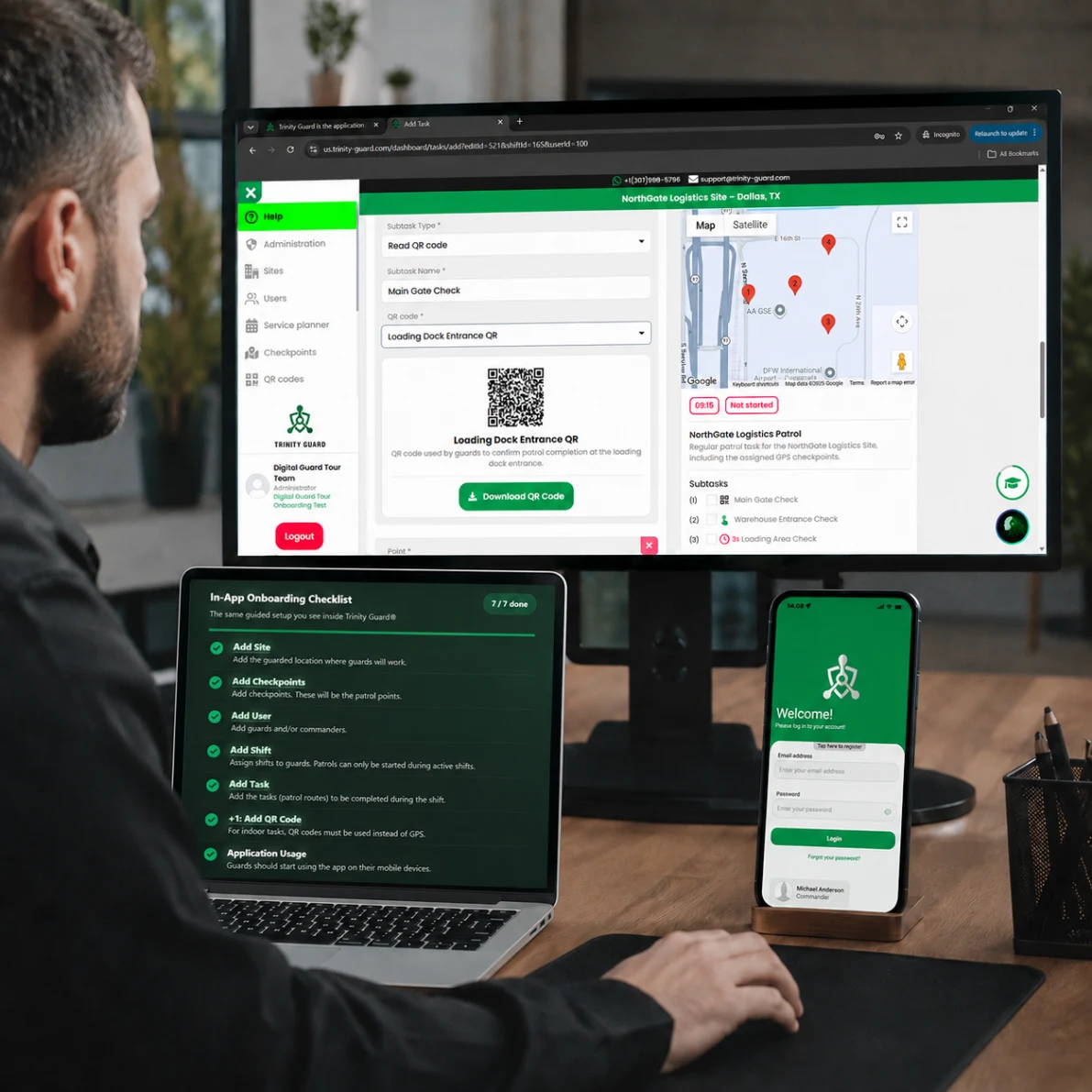
Digital Guard Tour, powered by Trinity Guard®, was built self-service from the ground up. A security company can start a free trial, set up its own sites, define QR and GPS checkpoints, invite guards, and run verified patrols — without a mandatory demo, a sales call, or an onboarding project. Setup is configuration the customer controls, not hardware someone installs.
The full feature set is intact in that self-service path: GPS-based outdoor checkpoint verification, QR checkpoints validated in real time by server-side AI against fake or cloned codes, incident reporting with photo evidence, and a supervisor dashboard. Self-service means the buying and deployment model is frictionless — not that anything is missing from the product.
And the enterprise path exists alongside it, optional rather than mandatory: organizations that need self-hosted deployment, formal security review, or a guided rollout can request a consultation. The default is buy-it-yourself; the guided option is there for the buyers whose governance requires it.
Atomic truth: Digital Guard Tour is a self-service guard tour system with an optional enterprise path — teams can deploy and run it themselves, while organizations that require a guided or self-hosted rollout can request one.
Try the self-service model yourself — no demo required
Start a free trial, set up your own sites and checkpoints, and run verified patrols the same day. GPS and QR verification, incident reports, and a supervisor dashboard — without proprietary hardware or a sales call.
No credit card required · Setup takes ~5 minutes · No proprietary hardware
Frequently asked questions
It is patrol verification software a security team can evaluate, buy, deploy, and operate on its own — without mandatory demos, sales calls, or vendor-led onboarding — typically by starting a free trial and setting up sites and checkpoints themselves.
Traditional systems require a demo request, a sales process, and a hardware implementation project before the product works. A self-service system lets the buyer try the real product and deploy it directly, going live in minutes rather than weeks.
No. Self-service describes the buying and deployment model, not the feature set. A self-service system like Digital Guard Tour still provides GPS and QR verification, incident reporting, photo evidence, and a supervisor dashboard.
Because self-service depends on being hardware-free. A smartphone-based system needs no equipment installed, so the customer can deploy it themselves. Systems built on RFID wands and checkpoint hardware still require someone to install that hardware.
Yes. Support and a guided enterprise path remain available for buyers who want them — including organizations that require self-hosted deployment or formal onboarding. The difference is that they're optional, not a prerequisite for the product to work.
About the author
Gyula Györfi · Former Police Commander · Founder of Trinity Guard®
Gyula Györfi is a former police commander with 26 years of security operations experience, including patrol supervision and the protection of sensitive diplomatic facilities in Budapest. He is the founder of Trinity Guard®, a software-based guard tour system designed to work without proprietary RFID scanners or dedicated patrol wands, used by security teams across multiple international regions.