
Introduction
Security patrols are often perceived as simple routine activities.
A guard walks through the property.
Checkpoints are scanned.
Reports are written.
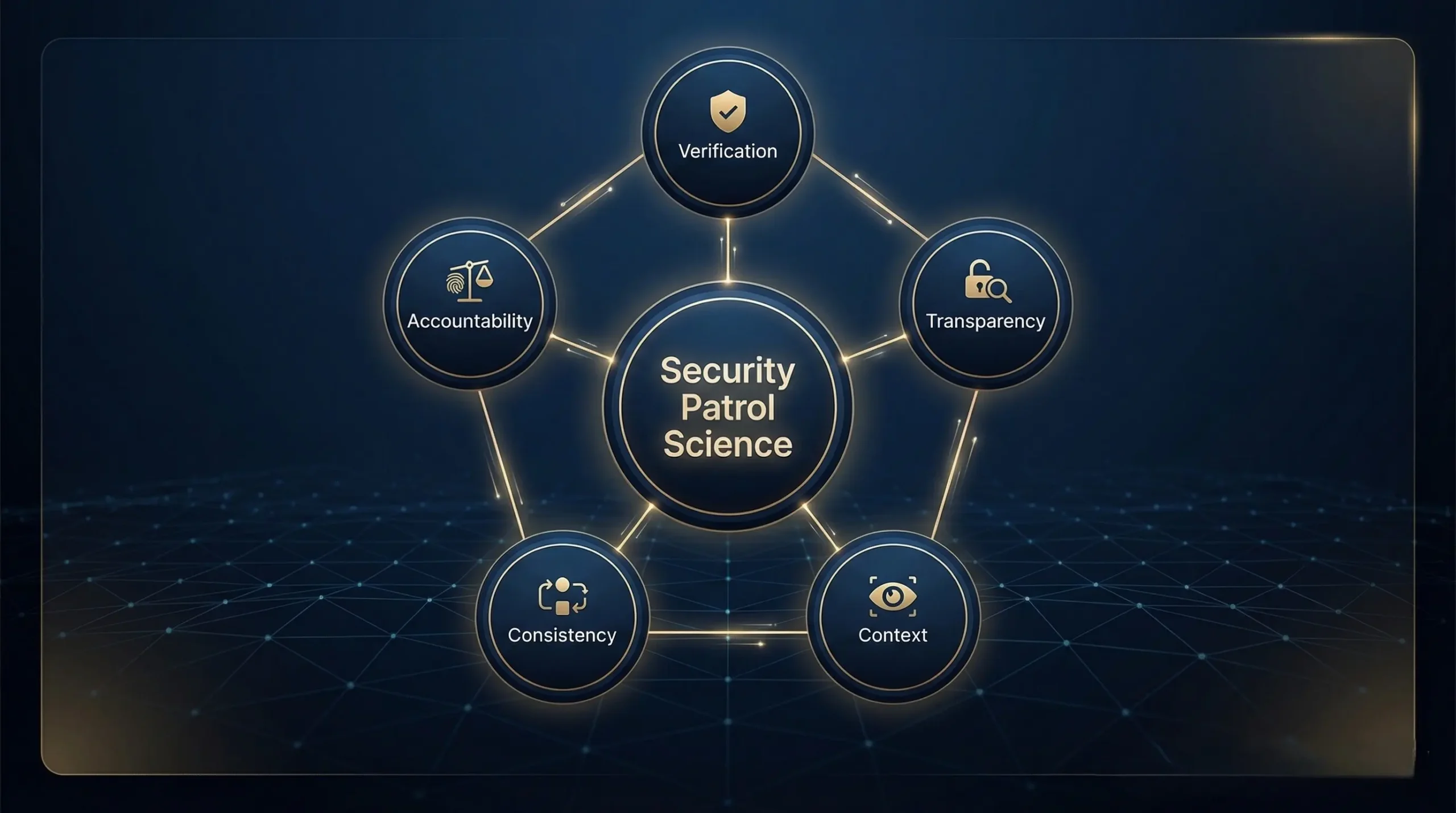
However, effective security patrol operations are not random tasks. They follow structured principles that originate from decades of operational experience, criminology research, and modern security management practices.
In the past, many organizations relied primarily on trust. If a guard reported that a patrol had been completed, the report itself was often considered sufficient evidence.
Today, this assumption is no longer acceptable.
Modern organizations require verification, transparency, and accountability in their security operations. As a result, patrol management has evolved from informal documentation toward structured operational systems .
Understanding the principles behind this transformation is essential for organizations that want reliable, professional security operations.
Below are five scientific principles that define modern guard patrol systems.
1. The Verification Principle
Security Work Must Be Verifiable
The presence of a security guard does not automatically prove that a patrol was actually completed.
Historically, many organizations relied on paper logbooks or simple RFID checkpoints. These methods could often be manipulated, filled out after the patrol, or completed without meaningful verification.
Modern guard patrol systems address this problem by introducing multiple verification mechanisms, such as:
- GPS-based location confirmation
- QR or digital checkpoint scanning
- timestamped activity records
- incident reports with photographic documentation
These mechanisms empower modern guard tour systems to generate objective operational proof for every patrol.
Atomic truth:
Security work that cannot be verified cannot be trusted.
Verification is the foundation of modern patrol accountability.
2. The Transparency Principle
Security Operations Require Real-Time Visibility
Traditional security supervision relied heavily on reports submitted after the end of a shift.
This approach created a fundamental problem: supervisors often discovered issues only after they had already occurred.
Modern security operations require real-time operational transparency.
Supervisors must be able to observe patrol activity as it happens, including:
- patrol progress
- checkpoint verification
- incident reporting
- operational irregularities
Real-time visibility transforms security management from reactive oversight into proactive supervision.
Instead of reviewing past events, organizations can respond to developing situations immediately.
Atomic truth:
Delayed reporting is documentation — not supervision.
3. The Context Principle
Security Data Must Be Interpreted in Context
Raw data alone does not guarantee effective security monitoring.
A timestamp or GPS coordinate does not automatically confirm that an activity occurred under the correct operational conditions.
Security data must always be interpreted within its operational context.
Relevant contextual questions include:
- Was the patrol actually started by the guard?
- Did the checkpoint scan occur during the assigned shift?
- Was the activity performed within the correct patrol zone?
- Was the incident reported at the correct location?
Without contextual interpretation, data becomes nothing more than isolated log entries.
Modern security systems increasingly rely on contextual analysis to ensure that patrol activities match expected operational conditions.
Atomic truth:
Security data without context is only a log entry.
4. The Operational Consistency Principle
Patrol Operations Must Follow Structured Processes
In many organizations, patrol execution historically depended on the individual habits of security guards.
This often resulted in inconsistent operations:
- missed checkpoints
- incomplete patrol routes
- undocumented incidents
- irregular reporting
Modern guard patrol systems introduce structured operational frameworks designed to eliminate these inconsistencies.
Examples include:
- predefined patrol checkpoints
- scheduled patrol shifts
- task-based verification requirements
- standardized incident reporting
These systems ensure that security operations follow a repeatable and controlled process, rather than relying on individual interpretation. A structured patrol plan — defining checkpoints, round frequency, and per-stop tasks before the shift begins — is what makes that consistency possible. Our free security patrol plan generator builds one for your site type and checks whether the route actually fits the shift.
Consistency is essential for maintaining professional security standards across multiple sites and teams.
Atomic truth:
Reliable security operations require structured processes.
5. The Accountability Principle
Security Operations Must Produce Audit-Ready Evidence
Modern organizations operate in environments where accountability and liability are increasingly important.
Security activity may need to be reviewed for several reasons:
- contractual verification
- regulatory compliance
- liability protection
- incident investigation
For this reason, security patrol systems must generate objective operational evidence.
Audit-ready records provide organizations with clear documentation of what actually occurred during security operations.
This documentation may later become critical when resolving disputes, evaluating incidents, or demonstrating contractual compliance.
Atomic truth:
Security operations must produce objective operational proof.
From Patrol Logs to Operational Proof
The security industry is currently undergoing a structural transformation.
Where patrol management once relied on handwritten notes, verbal confirmation, or isolated checkpoint scans, modern systems now emphasize verification, transparency, contextual analysis, and accountability.
This shift reflects a broader trend in professional security management.
Security operations are no longer judged solely by presence — they are evaluated by verifiable operational performance.
Organizations that adopt these principles create security systems that are more reliable, more transparent, and more defensible when incidents occur.
The future of security patrol management is not simply digital reporting.
It is verifiable operational transparency supported by a modern guard tour patrol system.
Before a patrol can be verified, it has to be planned. Defining the checkpoints, frequency, and route capacity up front is the step that turns a vague post order into an auditable patrol — a security patrol plan is where operational proof begins.
Organizations evaluating modern patrol platforms often compare different TrackTik alternatives when selecting a guard tour system.
Further Reading
- Crime Prevention Through Environmental Design (CPTED)
- Security Operations Management
- Security Transparency Frameworks
- Patrol Route Optimization Research
The Next Phase: From Verification to Intelligent Security Systems
Modern guard patrol systems are built on a foundation of verifiable operational history. Patrol activity is recorded, documented, and reviewed to ensure that security duties were actually performed.
Artificial intelligence is gradually transforming patrol verification systems from passive recording tools into intelligent operational support systems. Instead of simply documenting activity, advanced systems can interpret operational patterns and identify potential risks earlier.
Autonomous Verification
Computer vision technologies can verify real-world conditions, confirming whether physical states such as gates or doors match the expected security status.
Predictive Transparency
AI-assisted monitoring can detect operational anomalies, such as unusual patrol delays or deviations from expected patrol behavior.
Context-Aware Security Operations
Future systems may incorporate contextual factors such as time of day, environmental conditions, or historical incident data.
Adaptive Patrol Patterns
Advanced patrol management concepts may introduce dynamic patrol scheduling or strategic randomness to reduce predictability.
Continuous Operational Learning
Operational data can gradually improve patrol planning and incident response through feedback-driven security systems.
These developments do not replace the five scientific principles described in this article. Instead, they extend them. The future of security patrol management will continue to depend on verification, transparency, context, consistency, and accountability — increasingly supported by intelligent analytical systems.
The science of security patrols is evolving from documentation toward operational intelligence.