
How U.S. Security Teams Manage Vehicle Entry and Exit Without Paper Logs
Paper gate logs slow review, weaken documentation, and make it harder to prove what actually happened. Modern security teams use digital vehicle logging to create a searchable, time-stamped, reviewable access trail.
- Driver, carrier, cargo, waybill, timestamp, photos, site, and guard recorded in one workflow
- Entry and exit stay linked inside one digital timeline for faster supervisor review
- Stronger audit trail for logistics sites, industrial properties, airports, and multi-tenant operations
- Cleaner handoff between officers, dispatch, site supervision, and account leadership
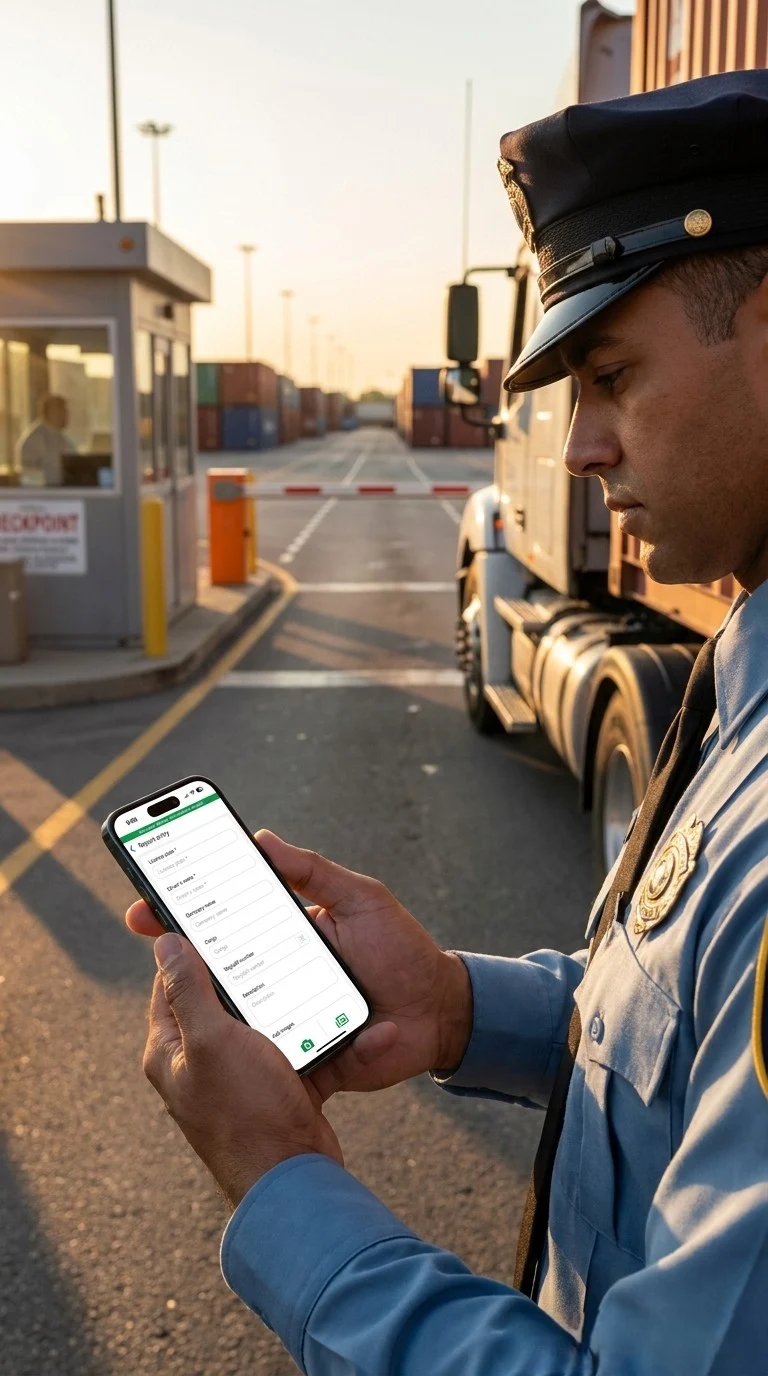
Paper gate logs still exist at thousands of U.S. properties, but they create the same problems every security director already knows: unreadable handwriting, missing trailer details, weak audit trails, slow supervisor review, and no fast way to verify what actually happened at the gate. For companies managing warehouses, cargo facilities, distribution centers, industrial sites, airports, and multi-tenant properties, that is no longer good enough.
Modern U.S. security teams manage vehicle entry and exit with a digital workflow that captures the event as it happens. Instead of relying on clipboards and end-of-shift memory, guards record each vehicle movement in the field using a mobile app. The result is a searchable, time-stamped, reviewable access record that operations leaders can actually use.
A modern vehicle entry and exit log should capture more than a plate number. At minimum, the record should include the driver’s name, carrier or company name, cargo description, waybill or shipment reference, photos, timestamp, site, and the guard who recorded the event. That is the difference between a basic note and a usable security record. For security companies that want vehicle access records, patrol proof, and supervisor visibility in one platform, Digital Guard Tour works as a complete guard tour system for modern field operations.
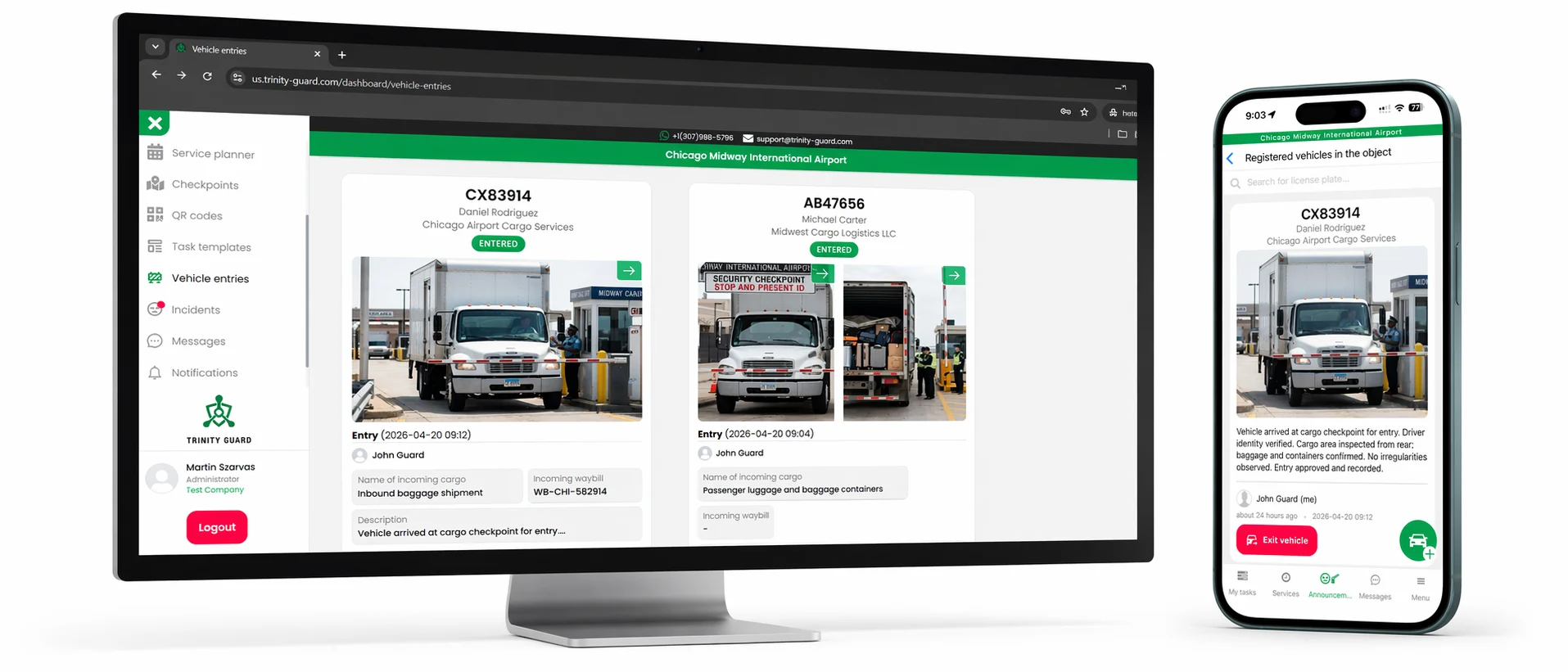
This is where digital vehicle logging changes the operational picture. The guard records the incoming vehicle at the gate, adds photos and key details, and saves the entry in real time. Later, when the same truck leaves the property, the officer can locate that record quickly and complete the exit. Entry and exit stay linked inside one digital timeline. That matters when a supervisor needs to review a discrepancy, confirm a shipment movement, answer a client question, or support an internal investigation. See the officer's side of this process in our truck gate check-in guide, or the full picture in our digital gate management system overview.
For U.S. operators, the value is not just convenience. It is accountability. A paper log may show that “a truck arrived.” A digital vehicle entry record can show who arrived, when, for what purpose, with what load, at which site, and which officer documented it. That creates a much stronger audit trail for logistics environments, contract security operations, and client-facing reporting. The same approach applies to plants and warehouses (see industrial site gate management) and to landfills and transfer stations (see the waste truck gate log system).
Digital logging also improves response speed. When a dispatcher, site supervisor, or account manager needs to find a vehicle record, they should not have to flip through pages or call the gatehouse. They should be able to search the log, review the photos, confirm the driver and cargo details, and move on. Faster retrieval means less confusion at shift change, fewer reporting gaps, and more confidence during audits, disputes, and after-action reviews.
The strongest systems also connect vehicle logs to the broader security operation. A vehicle movement should not live in isolation. It should remain tied to the site, the shift, and the guard activity around it. That gives security companies a cleaner operational picture and helps management defend service quality with real records instead of verbal explanations.
For companies still using paper, the issue is not tradition. It is exposure. Paper logs slow down review, weaken documentation, and make it harder to prove what happened.
Replace paper gate logs with a faster, cleaner digital workflow.
Record vehicle entry and exit in real time, keep driver and cargo details searchable, and give supervisors a stronger audit trail without clipboards, manual logbooks, or delayed review.