Manned Guarding Methods Compared: USA, Europe, Africa & South America
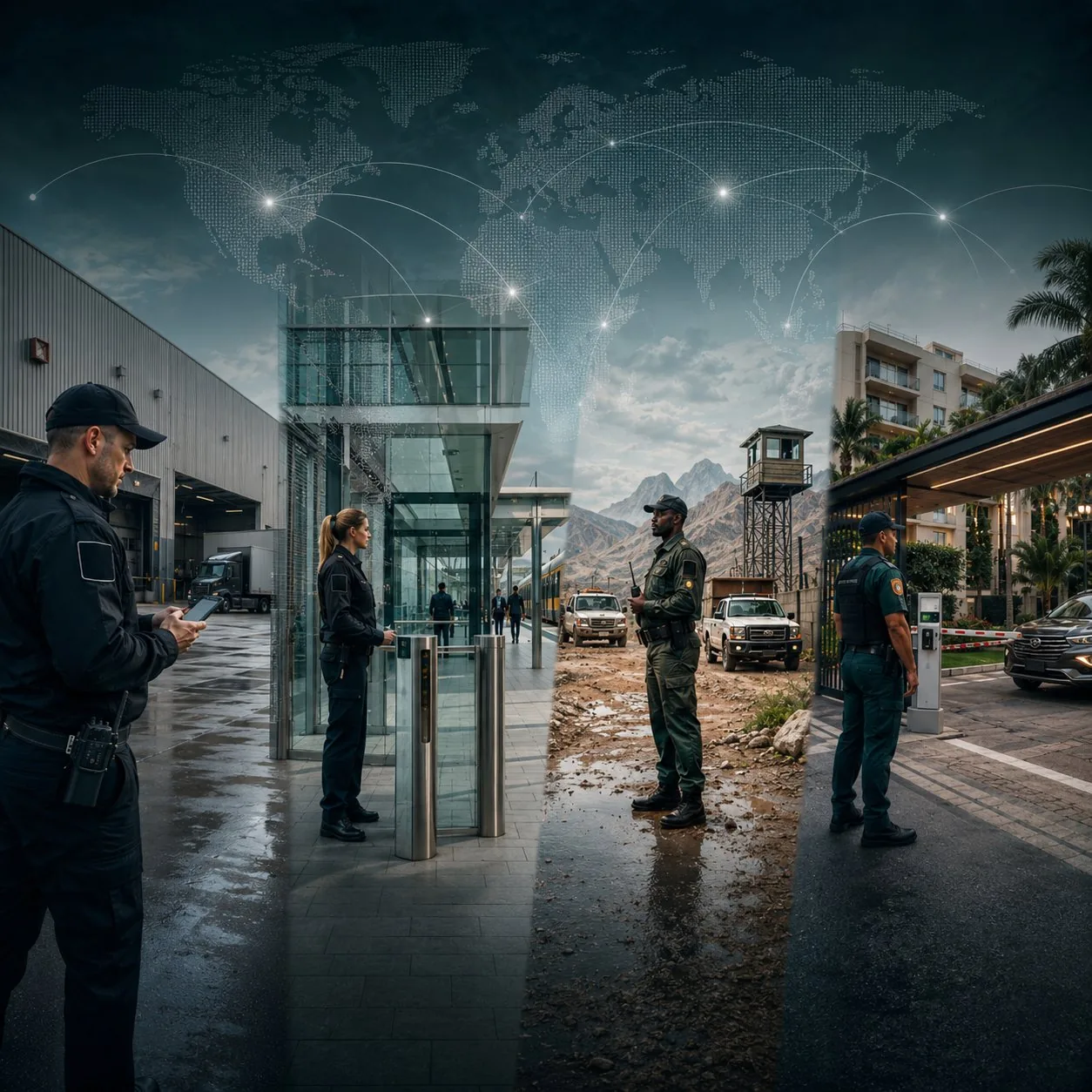
A security guard at a Texas distribution center, a shopping mall officer in Germany, an armed response operator in Johannesburg, and a condominium guard in São Paulo all wear a uniform — but they do not operate in the same security reality.
 Gyula GyörfiSecurity Operations Specialist & Veteran Police Commander · Founder of Trinity Guard®
Same Mission, Different Worlds
They are trained under different laws, paid under different labor systems, equipped under different firearms regimes, and supervised under completely different expectations. The American officer works inside a liability-driven contract market. The German officer works inside one of the most regulated, compliance-heavy labor frameworks in the world. The South African operator is part of the largest private security industry on the planet. The Brazilian guard belongs to a profession licensed and supervised directly by the Federal Police.
And yet, after 26 years in law enforcement — and having studied patrol verification technologies and guarding models across four continents in depth — I can tell you that every one of these markets quietly struggles with the same operational question:
How does a security company prove that the guard was actually there, actually checked what mattered, and actually responded when it counted?
This article compares manned guarding methods across the United States, Europe, Africa, and South America — regulation, patrol practices, armed versus unarmed culture, labor economics, client expectations, and technology adoption — and explains why, despite the differences, every region is converging on the same answer to that question.
What “Manned Guarding” Means Globally
Manned guarding — also called live guarding or physical security staffing — covers far more than a person standing at a gate. Across all four regions, the service family includes:
What differs by region is not the menu — it is the mix, and the operating model behind it.
Atomic truth: Manned guarding is not one global service category; it is a regional operating model shaped by crime risk, regulation, labor cost, technology, and client expectations.
United States: Contract-Driven, Liability-Conscious, Technology-Assisted
The scale
The United States runs the largest single-country private security market by value. The Bureau of Labor Statistics projects about 162,300 openings per year in the occupation — driven almost entirely by turnover, not growth. Those two numbers — 1.27 million officers and 162,000 annual openings — define the American operating reality: the industry must continuously recruit, onboard, and supervise a workforce that is permanently in motion.
The regulation
There is no federal security guard license. Regulation lives at the state level, and the spread is dramatic: mandatory unarmed training ranges from zero hours in some states to 40 hours in California and 42 hours in Florida. Armed endorsements typically add 12–47 hours of firearms training, range qualification, and stricter background screening. A guard company operating in five states effectively manages five separate compliance regimes.
The operating model
American guarding is overwhelmingly contract security: businesses outsource protection to specialized firms under service agreements with defined post orders, reporting requirements, and liability allocation. Contract security revenue grew roughly 50% between 2014 and 2022, and the competitive structure is unforgiving — a handful of national giants at the top, thousands of small and mid-size regional companies underneath, and clients who can re-bid the contract at every renewal.
That structure explains the defining trait of U.S. guarding: documentation as a survival skill. In a market where one negligence lawsuit or one lost audit dispute can erase a year of margin, the question is never just “do we have a guard on site?” It is “can we prove, with timestamps, what that guard did?” This is why mobile reporting through a security guard app, dispatch software, and a digital guard tour patrol system penetrated the American market earlier and deeper than almost anywhere else — daily activity reports, incident logs, and checkpoint scans are not back-office paperwork; they are the deliverable the client is paying for.
Europe: Regulated, Training-Focused, Compliance-Heavy
The scale
Europe's private security sector is represented by CoESS — the Confederation of European Security Services, whose member federations span roughly 45,000 companies employing about 2 million security officers. The EU-27 alone counted more than 46,000 firms in official statistics; Germany, France, the UK, and Spain anchor an industry worth well over €40 billion annually.
The regulation
European guarding is licensed nationally, but the floor is far higher and far more uniform than in the United States. Most member states require state-approved pre-employment training measured in dozens to hundreds of hours, criminal record vetting, and formal examinations — Spain's vigilante de seguridad qualification and the Nordic systems sit at the demanding end. CoESS and the trade union federation UNI Europa have driven sector-wide vocational standards since the 1990s, and in several countries — Hungary, Belgium, Sweden, Spain, and Portugal among them — licensed private security is formally entrusted with tasks adjacent to public policing: airport screening, transport security, support roles for municipal authorities.
Three structural forces shape the European model:
- Collective bargaining. Wages, night premiums, and working time are negotiated sector-wide in many countries. This compresses wage-based competition and pushes differentiation toward quality, compliance, and technology.
- Low-bid public procurement. Government contracts are a major revenue source, and price-only tendering is the industry's most persistent complaint — CoESS has campaigned for “best value” procurement for years.
- Labor shortage. Europe's guarding sector faces a chronic recruitment gap, which accelerates interest in efficiency tools: one verified mobile patrol covering thirty client sites instead of thirty static posts.
The armed question
Europe is the unarmed continent. Firearms in private security are exceptional, tightly licensed, and confined to niches such as cash-in-transit and select critical infrastructure. Deterrence rests on presence, procedure, and fast escalation to police — not on guard firepower.
The European differentiator: the mobile patrol and alarm-response economy
Because static 24/7 manning is expensive at European wage levels, the continent perfected the shared mobile patrol: one vehicle, one officer, dozens of client sites per night — scheduled checks, keyholding, alarm response. The model is verification-hungry by design. A client paying for three nightly visits never sees them happen, so European contracts routinely require electronic proof of every visit. GDPR adds a final layer: guard monitoring must be proportionate and privacy-compliant, which favors checkpoint-based verification — the officer scans a point at the site — over continuous personal tracking.
Atomic truth: European guarding is less about replacing the state and more about regulated cooperation, certified training, and documented service quality.
Africa: High-Variance, Manpower-Heavy, Risk-Driven
Africa is not one market. The three anchor countries below represent the widest spread of guarding models found anywhere in the world — from the most developed private security industry on Earth to a major economy where private guards are barred from carrying firearms at all.
South Africa: the world's most developed private security industry
South Africa is a category of its own. The regulator PSIRA — the Private Security Industry Regulatory Authority lists over 2.5 million registered security officers, of whom roughly 550,000–600,000 are actively deployed — more than the police and army combined. (When comparing figures, note the distinction: registered officers include an inactive reserve; active officers are those currently deployed.) PSIRA operates a graded competency ladder (Grades E through A) running from basic patrolling to site and operations management, with specialized certifications for armed response, cash-in-transit, and National Key Point critical infrastructure protection.
The signature South African product is armed response: subscription-based, radio-dispatched tactical vehicles that respond to residential and commercial alarms within minutes, staffed by firearm-qualified officers. It is a privatized rapid-reaction layer operating at a scale that exists nowhere else — and it sits on top of a deeply technology-integrated industry where monitoring centers, estate security, and asset-in-transit protection routinely combine manpower with electronics. At the top end of the market, electronic patrol verification is standard; at the low end, the paper occurrence book still survives.
Nigeria: guarding without guns, by law
Nigeria inverts the South African model completely. The Private Guard Companies Act of 1986 requires private security companies to be licensed and Nigerian-owned — and prohibits them from using firearms. Armed protection is reserved for the state: clients who need armed escorts contract police units (commonly MOPOL, the Mobile Police) to operate alongside unarmed private guards. With more than 1,100 licensed guard companies, an estimated one million people employed in the sector, and persistent insecurity driving demand, Nigeria runs the world's largest mandatorily unarmed guarding industry — a hybrid model in which the private guard observes, controls access, and reports, while the state supplies the force.
Kenya: formalization in real time
Kenya shows what African professionalization looks like as it happens. The Private Security Regulation Act (2016) created the PSRA — Kenya's Private Security Regulatory Authority, which has since introduced mandatory accredited training, national registration with individual Guard Force Numbers for every officer, deregistration of non-compliant companies, and a government-set minimum gross wage of KSh 30,000 (~USD 230) per month — a directive contested by industry associations and ultimately upheld by the High Court in February 2025. The trajectory is unmistakable: a huge, labor-intensive workforce being pulled, regulation by regulation, from informality toward licensed, traceable, minimum-wage professionalism.
The continental pattern
Across most African markets, guarding is manpower-heavy: where a U.S. site deploys one technology-supported officer, an African site often deploys three guards on rotation, because low wages make headcount affordable. But high headcount across many dispersed sites makes supervision the binding constraint — the supervisory layer is thin, distances are long, and paper logs travel slowly. This is precisely why mobile-first, hardware-free GPS patrol verification is leapfrogging in Africa the way mobile banking did: the guard already carries a phone; the legacy RFID infrastructure simply never gets built.
Atomic truth: In many African markets, private security is not merely a commercial service; it functions as part of the practical security infrastructure around homes, businesses, logistics, and critical assets.
South America: Risk-Intensive, Access-Control-Heavy, Often Armed
The security context
No region's guarding industry is shaped more directly by crime pressure. Latin America accounts for roughly a third of the world's intentional homicides with about 8% of its population, and 17 of the 20 countries with the highest homicide rates are in the region. The result is the most police-displacing private security market on Earth: regional studies by DCAF — the Geneva Centre for Security Sector Governance and UNLIREC identified more than 16,000 private security companies employing approximately 2.4 million formal guards — before counting a vast informal sector. In Brazil, private guards outnumber police roughly four to one; in Guatemala five to one; in Honduras nearly seven to one.
Brazil: federal control of an armed profession
Brazil regulates private security harder than almost any country in the world. Federal Law 7.102 of 1983 — still the sector's legal backbone — places the entire industry under Federal Police supervision. The licensed guard (vigilante) must complete a formation course at a Federal Police–accredited academy, pass physical, mental, and psychotechnical examinations, register individually with the Federal Police, and recertify periodically. Armed guarding is normal and codified down to the permitted service revolver calibers, and foreign ownership of guarding companies is prohibited by law.
The formal sector is large and professional: industry federation Fenavist reported approximately 571,000 active vigilantes in 2025 (up more than 7% year over year), working across roughly 2,500 specialized companies, in a national security services market worth about $15 billion — roughly 60% of all Latin American security revenue. Alongside it runs a parallel informal market, including the off-duty police moonlighting culture (the bico), which the law excludes but practice tolerates.
The wider region
Chile modernized its framework with Law 21.659 (2024), the country's first comprehensive private security statute, strengthening training, specialization, and coordination with public forces. Colombia operates one of the region's more structured regimes under the Superintendencia de Vigilancia y Seguridad Privada, with armed guarding common. Across the Andean countries, the DCAF–UNLIREC findings repeat: incomplete legal frameworks, limited regulator capacity, large informal markets — and state entities themselves among private security's biggest clients.
The operating model
Day to day, South American guarding is access-control-heavy. The condominium gate, the vehicle checkpoint, the truck inspection at the logistics yard, the bank entrance — controlled entry is the center of gravity, supported by visible deterrence and, in many segments, armed posts. Client expectations follow the risk environment: presence alone is not the product; rapid reaction and provable incident handling are. In a market where the boundary between formal and informal operators is blurry, a timestamped, GPS-anchored patrol and incident trail carries weight it has nowhere else — it is evidence of legitimacy, for clients, insurers, and regulators alike.
Atomic truth: South American guarding is shaped by a higher-risk environment in which access control, visible deterrence, and documented incident handling matter as much as routine patrol presence.
What Is the Same Everywhere
Strip away the regional differences and seven constants remain — and they are the most strategically important findings in this comparison:
- Presence alone is not enough. Every market has learned that an unverified guard post delivers deterrence only as long as the guard is actually awake, present, and patrolling.
- The night-shift accountability gap is universal. Most guarding value is delivered between 10 PM and 6 AM — exactly when no manager is watching. This is true in Dallas, Dortmund, Durban, and Belo Horizonte.
- Supervisors want remote visibility. Whether the supervisory layer is thick (Europe) or thin (much of Africa), the operational need is identical: know what is happening across sites without driving to them.
- Clients want proof. The American client wants it for liability. The European client wants it for contract compliance. The African client wants it to manage headcount. The South American client wants it as evidence of formality. Different reasons — same deliverable.
- Paper logs fail everywhere. The signed-but-not-walked patrol log is not a regional defect; it is a structural property of unverified night work, documented on every continent.
- Turnover demands simplicity. With the U.S. generating 162,000 openings a year and comparable churn dynamics worldwide, any system a guard must use has to be learnable in minutes, not weeks.
- The smartphone is already on site. From a Chicago high-rise to a Mombasa warehouse, the one piece of hardware every modern guard already carries is a phone. No other verification infrastructure can claim global, pre-installed coverage.
Atomic truth: The global guarding industry differs by region, but the operational weakness is the same everywhere — patrol work is difficult to trust if it is not digitally verified.
What Is Fundamentally Different
| Dimension | USA | Europe | Africa | South America |
|---|---|---|---|---|
| Core logic | Contract service, liability, client proof | Compliance, licensing, certified quality | Practical risk protection at high headcount | High-risk deterrence + access control |
| Typical methods | Post orders, patrols, access control, daily activity reports | Regulated static guarding, shared mobile patrol, alarm response | Perimeter & estate guarding, armed response (SA), police-partnered escorts (NG) | Gate & vehicle control, condominium and bank guarding, armed posts |
| Regulation | State-by-state; training 0–42+ hours; no federal license | National licensing, high training floors, CoESS/UNI standards | Maturing regulators (PSIRA, PSRA); capacity varies | National; Brazil under Federal Police; informality widespread |
| Armed posture | Legal & routine in niches; majority unarmed | Exceptional; effectively unarmed industry | Full spectrum: core product (SA) to prohibition (NG) | Common and codified in major markets |
| Main risk | Turnover, audit disputes, negligence liability | Labor shortage, low-bid procurement | Regulation gaps, thin supervision, use-of-force exposure | Crime pressure, trust deficit, incident liability |
| Technology direction | Mobile reporting, dispatch, patrol verification | GDPR-compliant checkpoint proof | Mobile-first leapfrog, monitoring + phone-based proof | Access logs, incident evidence, formality signal |
The five deepest divides
- Who holds the gun. Europe and Nigeria answer: the state. South Africa and Brazil answer: licensed private officers. The United States answers: it depends on the state and the site.
- Who responds to alarms. South Africa privatized rapid response. Europe built shared mobile patrols that escalate to police. The U.S. blends on-site response with police dependence. South America often hardens the site instead — because in many places, nobody reliably comes.
- What a guard hour costs. A fully loaded guard hour runs roughly $1.50–3.00 in parts of Africa and Latin America versus $25–45+ in the U.S. and Western Europe. That 15–20× spread dictates headcount density, supervision models, and how fast technology pays for itself.
- Where regulation lives. Federal (Brazil), national (most of Europe and Africa), or state-by-state (USA, Mexico). The locus of regulation determines whether a security company scales smoothly or rebuilds compliance in every new territory.
- The informality line. In the U.S. and Europe, an unlicensed guard company is an anomaly. In much of Africa and Latin America, the informal sector rivals the formal one — which transforms verification from an efficiency tool into a market-access credential.
Why Digital Patrol Verification Becomes Universal
Here is the strategic conclusion of this comparison.
A U.S. warehouse, a European logistics hub, a South African residential estate, and a Brazilian condominium do not need the same guarding strategy. They genuinely differ — in law, in labor, in weapons, in risk. But they all need the same thing underneath: reliable, timestamped proof that assigned security work was actually completed.
For decades, that proof required hardware: mechanical watchclocks, then iButton wands, then RFID and NFC checkpoints. Hardware works — but it imports a rich-market cost structure into every deployment: devices to purchase, tags to install, readers to replace, infrastructure to maintain. That model fits a $40-per-hour Munich contract. It does not fit a $2-per-hour post in Lagos, a 40-site mobile route in rural Spain, or a three-guard startup company in Texas trying to win its first commercial account.
This is why the industry is converging, on every continent, on hardware-free verification: the guard's existing smartphone running a guard tour app as the scanner, GPS coordinates and printable QR codes as the checkpoints, the cloud as the control room. The same system satisfies a GDPR-conscious European client, a litigation-conscious American one, a span-of-control problem in East Africa, and a formality requirement in Brazil — because it verifies the one thing every model has in common: presence.
Atomic truth: GPS- and QR-based patrol verification works identically in every regulatory environment because it verifies presence — not weapons policy, wage levels, or legal tradition.
Conclusion: The Future of Manned Guarding
The world's guarding models are not going to converge. Europe will not arm its guards; Nigeria will not disarm its police escorts; South Africa will not shrink its armed response fleets; the United States will not federalize its licensing. The differences described in this article are durable, because they are rooted in law, history, and risk — not in fashion.
What is converging is the standard of proof. Regulators are building national guard registries from Nairobi to Brasília. Insurers and courts on every continent increasingly treat electronic patrol records as the baseline of due diligence. Clients everywhere have learned to ask the same question at contract renewal: show me the data.
The future of manned guarding is not fewer guards. It is better-documented, better-supervised, and digitally verifiable guard work — on every continent, at every wage level, under every flag.
Manned guarding is a regional operating model shaped by crime risk, regulation, labor cost, technology, and client expectations — not one global service category. The U.S. market is contract-driven and state-regulated (~$49–50B, 1.27M guards); Europe is nationally licensed, training-intensive, and largely unarmed (~2M officers). South Africa runs the world's largest private security industry per capita (2.5M+ registered officers), Nigeria legally prohibits private firearms, and Kenya is formalizing the sector through the PSRA. In South America, private guards outnumber police (Brazil ~4:1), with Brazil's industry under direct Federal Police supervision since Law 7.102/1983. Every region converges on the same requirement: digitally verified, timestamped proof of patrol presence — increasingly delivered by hardware-free GPS/QR systems.




Frequently Asked Questions
The U.S. runs a state-regulated, contract-driven market with low and uneven training floors (0–42+ hours) where documentation and liability management dominate. Europe runs nationally licensed, training-intensive, largely unarmed guarding shaped by collective agreements, public procurement, and GDPR-compliant verification requirements.
By market value, the United States (~$49–50 billion in 2026). Relative to population, South Africa — over 2.5 million registered officers, roughly 550,000–600,000 actively deployed, outnumbering its police and army combined.
No. Most guard hours worldwide are unarmed. Armed guarding is core to the model in South Africa, Brazil, and Colombia, situational in the United States, exceptional in Europe, and legally prohibited for private companies in Nigeria.
Because demand for protection has outgrown public policing capacity. Where police response is slow or absent, private guarding fills the gap — producing ratios of roughly 4:1 in Brazil, 5:1 in Guatemala, and nearly 7:1 in Honduras.
Yes. GPS- and QR-based verification requires only a smartphone and a cloud connection, so it operates identically under U.S. state licensing, European GDPR rules, PSIRA or PSRA regulation in Africa, and Federal Police oversight in Brazil. Only the business motive differs: client retention in the U.S., contract compliance in Europe, supervision at scale in Africa, and proof of formality in South America.
Gyula Györfi
Security Operations Specialist & Veteran Police Commander · Founder of Trinity Guard®
Gyula Györfi served 26 years in law enforcement, rising from sergeant to lieutenant colonel, including patrol supervision and the protection of sensitive diplomatic facilities in Budapest. He is the founder of Trinity Guard®, a hardware-free GPS/QR patrol verification platform used by security companies on four continents.
Trinity Guard® Around the World
This analysis is informed by Trinity Guard® operations and localized patrol verification resources across multiple regions:
Data Sources
- U.S. Bureau of Labor Statistics — Security Guards (SOC 33-9032) — employment, openings, median pay
- CoESS — Confederation of European Security Services — European industry structure and standards
- PSIRA — Private Security Industry Regulatory Authority, South Africa — registration and grading data
- PSRA — Private Security Regulatory Authority, Kenya — Private Security Regulation Act 2016, Guard Force Numbers, minimum wage notices
- Lei nº 7.102/1983 — Presidência da República, Brazil — Federal Police regulation of private security
- DCAF & UNLIREC — “Armed Private Security in Latin America and the Caribbean”
- Private Guard Companies Act No. 23 of 1986 (Nigeria) · Ley 21.659 (Chile, 2024) · Fenavist (Brazil, 2025) · Igarapé Institute homicide concentration data
Prove Every Patrol — On Any Continent
Trinity Guard® delivers hardware-free, GPS/QR-based patrol verification that deploys in an afternoon: no devices to ship, no checkpoints to wire, no per-guard hardware cost. The same proof of presence — from Texas to Nairobi to São Paulo.