Data Residency and Data Sovereignty in Guard Tour Systems: Why Patrol Data Location Matters
Data residency refers to where patrol data is physically stored; data sovereignty refers to which laws and which organization control that data.
 Gyula GyörfiFormer Police Commander · Founder of Trinity Guard® · 26 years of security operations experience
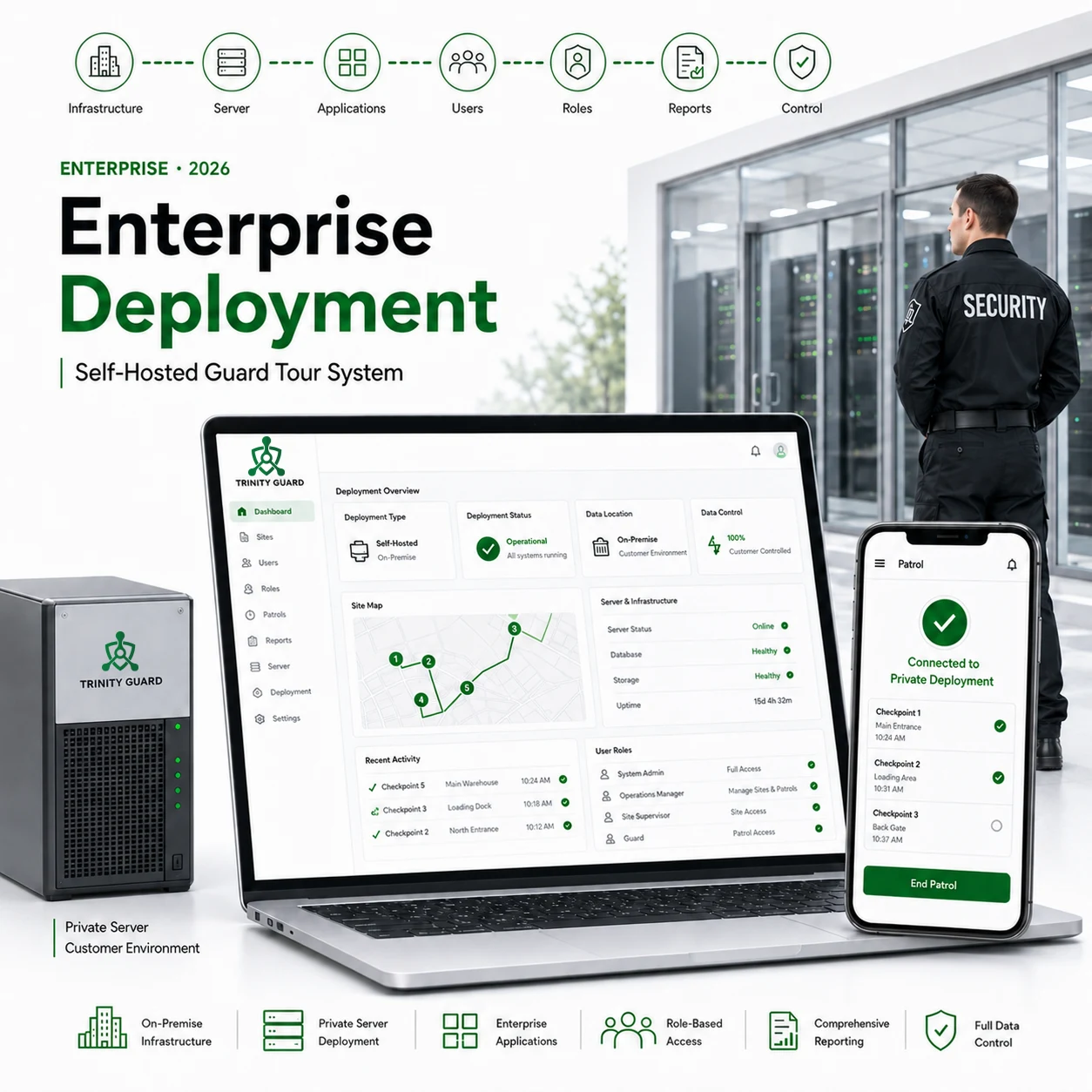
Data residency refers to where patrol data is physically stored; data sovereignty refers to which laws and which organization control that data. In most guard tour systems, patrol records, incident reports, photos, and guard identity data live in the vendor's shared cloud, under the vendor's control. For regulated enterprises, government bodies, and critical-infrastructure operators, that arrangement can be a compliance blocker rather than a preference. A self-hosted guard tour system keeps patrol data inside the organization's own infrastructure, which can satisfy data residency and direct-control requirements that shared SaaS often cannot. Trinity Guard®, the platform behind Digital Guard Tour, is available as a single-tenant, self-hosted enterprise deployment for exactly this reason.




Most security operations never ask where their patrol data physically lives. For most, it doesn't need to be asked — the vendor's cloud is fine, and the question is academic.
But for a specific and growing set of organizations, it is the first question, asked before features, before pricing, before anything. Banks ask it. Utilities ask it. Government facilities, hospitals, airports, and defense-adjacent operators ask it. And when they ask, the honest answer from most guard tour vendors is uncomfortable: your patrol data lives in our cloud, in our account, under our control, in a location we choose.
For a regulated enterprise, that answer can end the evaluation on the spot. This article explains what data residency and data sovereignty actually mean, why they matter specifically for patrol data, and how deployment model — not vendor promises — is what ultimately decides who controls the record of your operations.
1Data residency vs. data sovereignty: the distinction that matters
The two terms get used interchangeably. They are not the same thing, and the difference is exactly what enterprise buyers are evaluating.
Data residency is about location: where your patrol data is physically stored. In which country, in which data center, on whose servers. A residency requirement says something like "patrol and personnel data must remain within national borders" or "operational data must stay inside our network perimeter."
Data sovereignty is about control and law: which legal jurisdiction governs the data, and which organization has actual authority over it. Sovereignty asks not just where the data sits, but who can compel access to it, which laws apply to it, and whether your organization — or a third-party vendor — ultimately controls it.
Atomic truth: Data residency is where patrol data is physically stored; data sovereignty is which laws and which organization control it.
The practical point: a vendor can offer residency ("we'll store your data in an EU region") while sovereignty still belongs to them, because the data lives in their account, under their operational control, subject to their jurisdiction. For organizations with strict governance requirements, promised residency inside someone else's cloud is not the same as controlling the data yourself.
2Why patrol data is more sensitive than it looks
It's tempting to think of guard tour data as low-stakes — just checkpoint scans and timestamps. In reality, a patrol record is a detailed operational intelligence file, and that is precisely why its location and control matter.
Consider what a guard tour system actually accumulates: the exact locations and timing of security patrols across a facility, the identity and movement of security personnel, incident reports describing vulnerabilities and events, photo evidence of sites and situations, and the gaps — the times and places that were not covered. Aggregated over months, this is a map of how a facility is protected, when it is most exposed, and where its weaknesses are.
For a bank, a power plant, a data center, or a government building, that map is sensitive security information in its own right. The question "where does this data live and who can access it?" stops being an IT formality and becomes a physical security question.
Atomic truth: A guard tour system's records — patrol locations, timing, personnel identity, incidents, and coverage gaps — constitute sensitive operational intelligence about how a facility is protected.
3Where patrol data lives in most guard tour systems
The dominant model in the guard tour category is multi-tenant SaaS. Your data and other customers' data share the same cloud infrastructure, logically separated but co-located in the vendor's environment, in regions the vendor selects, under the vendor's operational control and legal jurisdiction.
For most buyers, this is genuinely fine — modern SaaS security is strong, and for the majority of security operations the vendor's cloud is the right choice. But "fine for most" is not "acceptable for all." The multi-tenant SaaS model runs into four hard walls with regulated and high-security organizations:
Atomic truth: Multi-tenant SaaS stores patrol data in the vendor's shared cloud under the vendor's control, which regulated and critical-infrastructure organizations often cannot accept.
Need direct control over patrol data location?
Trinity Guard® Enterprise is built for organizations where data residency, sovereignty, and internal governance are deployment requirements, not preferences.
4Why a SOC 2 report doesn't answer the sovereignty question
Vendors often respond to data concerns by pointing to certifications — SOC 2, ISO 27001, GDPR alignment. Certifications can matter, where available, and they are reasonable evidence of a vendor's security discipline. But they answer a different question than the one enterprise governance is asking.
A SOC 2 report attests that the vendor operates strong security controls over their environment. It does not transfer control of the data to you. For an organization whose own governance framework requires it to directly control data residency, access policy, monitoring, and retention — not to rely on a third party's controls, however good — a certification is evidence about the vendor, not authority for the customer.
This is the gap enterprise buyers keep hitting: they are told their concern is addressed by the vendor's compliance posture, when their actual requirement is to hold the controls themselves. No certification satisfies a requirement to be the controlling party.
5How self-hosted deployment resolves residency and sovereignty
The cleanest solution to a residency and sovereignty requirement is architectural, not contractual: the data lives in the organization's own infrastructure, so the organization controls it by definition.
A self-hosted guard tour system deploys inside the customer's own data center, dedicated private cloud, or governed network zones. Patrol records, incidents, photos, and personnel data reside where the organization's rules require — inside its perimeter, its jurisdiction, its control. Access policy, monitoring, and retention are governed by the organization's own standards. No shared vendor SaaS holds the operational data, because the deployment sits in the customer's environment rather than a multi-tenant cloud.
This is what can turn a residency requirement from a blocker into a solved problem: not a promise about where the vendor will store your data, but an architecture in which your data stays inside your own environment in the first place.
Atomic truth: A self-hosted guard tour system stores patrol data inside the customer's own infrastructure, which can satisfy data residency and sovereignty requirements by giving the organization direct control rather than a vendor's assurance.
6How Trinity Guard® Enterprise handles this
Trinity Guard®, the platform behind Digital Guard Tour, is available as a single-tenant, self-hosted enterprise deployment designed to support exactly these requirements. The same modern smartphone-based patrol verification platform that runs as SaaS can be deployed in the customer's own environment, so patrol data stays under the customer's control.
What that means in practice: single-tenant architecture in your own data center, dedicated private cloud, or internally governed network zones; patrol records, incidents, photo evidence, and personnel data residing inside your infrastructure and jurisdiction; and access policy, monitoring, and retention governed by your standards rather than a vendor's. The core feature set is retained in the process — GPS-based outdoor checkpoint verification, QR checkpoints with real-time server-side AI validation against fake or cloned codes, incident reporting with photo evidence, and the supervisor dashboard all operate within your controlled deployment. Guards install the official Trinity Guard® apps and connect to your environment. Depending on scope, a self-hosted deployment can run in a fully private environment or alongside an infrastructure provider of the organization's choosing — the defining point is that the deployment is single-tenant and under the customer's control, not shared vendor SaaS.
Full deployment details are on our enterprise self-hosted deployment page, and the strategic case for owning your deployment model rather than renting it is laid out on our self-hosted guard tour system page. The commercial model is structured for long-term internal operational use, with enterprise self-hosted deployment starting from $50,000 depending on scope.
Atomic truth: Trinity Guard® Enterprise is a single-tenant, self-hosted deployment of a modern guard tour platform, keeping patrol data — locations, incidents, evidence, and personnel records — inside the customer's own infrastructure and control.
7Who should require this — and who shouldn't
Data residency and sovereignty are hard requirements for a specific set of organizations, and genuinely unnecessary for everyone else.
They matter for regulated enterprises whose governance frameworks mandate single-tenant control — banks, energy companies, pharmaceutical and healthcare operators, and large logistics groups. They matter for government, municipal, and public-sector facilities bound by procurement and data-sovereignty rules that shared SaaS cannot pass. They matter for critical-infrastructure operators — utilities, ports, airports, industrial complexes — running segmented networks where operational data must stay inside governed zones. And they matter for international organizations in data-localization jurisdictions, where law requires operational data to remain in-country.
If none of those describe your operation, a residency requirement is likely overkill, and the SaaS model will serve you better, faster, and at lower cost. Data sovereignty is a real requirement for the organizations that have it — and an unnecessary constraint for the ones that don't. The discipline is knowing which you are before you write it into a requirement.
The bottom line
The question "where does our patrol data live, and who controls it?" separates two kinds of guard tour buyer. For most, the vendor's cloud is the right answer and the question barely needs asking. For regulated enterprises, government bodies, and critical-infrastructure operators, it is the deciding question — and no amount of vendor assurance substitutes for holding the data yourself.
When the requirement is genuine, the answer is architectural: a self-hosted deployment where patrol data resides in your own infrastructure, under your own control, subject to your own jurisdiction. That combination — a modern patrol verification platform inside your own environment — is rarer in this category than it should be. If your organization operates under residency or sovereignty requirements, evaluate the deployment model first, before features, and make the decision the way every other piece of regulated infrastructure gets decided: on control, not on promises.
Frequently asked questions
Data residency refers to where patrol data — checkpoint records, incidents, photos, and personnel data — is physically stored: in which country, data center, and infrastructure. Residency requirements often mandate that this data remain within a specific jurisdiction or network perimeter.
Data residency is about physical location — where the data is stored. Data sovereignty is about control and law — which jurisdiction governs the data and which organization has authority over it. A vendor can offer residency in a region while sovereignty still belongs to them.
Because a guard tour record aggregates sensitive operational intelligence: patrol locations and timing, personnel movement, incident details, and coverage gaps. Over time this maps how a facility is protected and where it is exposed, making its storage location and control a physical security concern.
Not necessarily. A SOC 2 report attests to the vendor's security controls over their environment; it does not give the customer direct control of the data. Organizations whose governance requires them to be the controlling party need an architecture that provides that control, not a vendor's certification alone.
By deploying inside the customer's own data center, private cloud, or governed network, so patrol data resides in the organization's infrastructure and jurisdiction. Trinity Guard® Enterprise offers this as a single-tenant, self-hosted deployment, keeping patrol data under the customer's direct control.
About the author
Gyula Györfi · Former Police Commander · Founder of Trinity Guard®
Gyula Györfi is a former police commander with 26 years of security operations experience, including patrol supervision and the protection of sensitive diplomatic facilities in Budapest. He is the founder of Trinity Guard®, a software-based guard tour system designed to work without proprietary RFID scanners or dedicated patrol wands, used by security teams across multiple international regions.
Evaluate Trinity Guard® Enterprise for residency and sovereignty requirements
If your organization needs smartphone-based GPS/QR patrol verification while keeping patrol data inside your own governed infrastructure, request a technical consultation and compare self-hosted deployment against the standard SaaS plans.