Guard Tour System Market: Size, Trends & Statistics (2026)

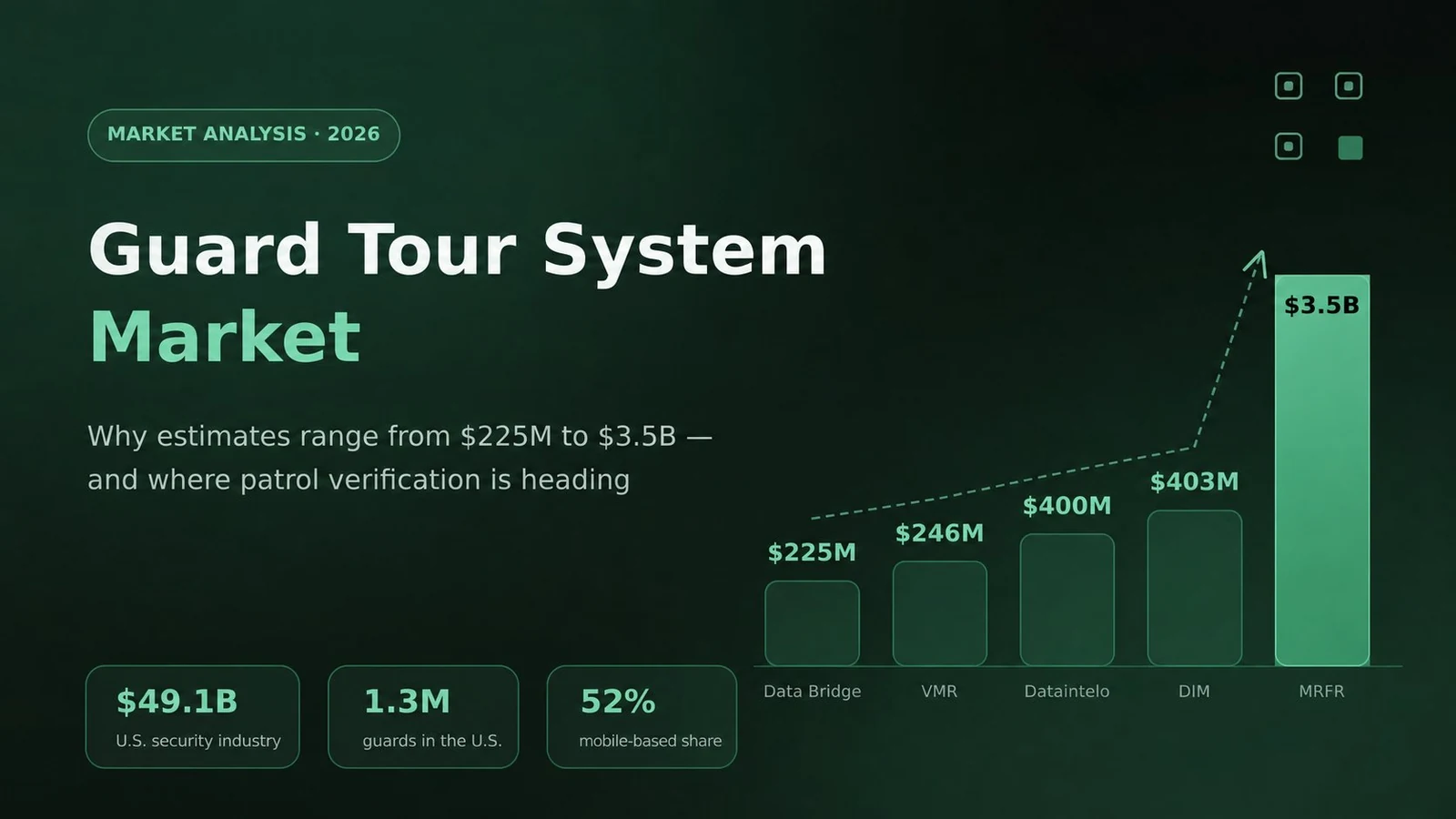
The guard tour system market is a segment of the security technology industry covering hardware and software used to verify security patrols. Market size estimates for 2026 range from roughly $230 million (hardware-centric definitions) to over $3.5 billion (broader software and services definitions), with growth forecasts between 2.5% and 9.75% CAGR. The market is shifting from RFID hardware toward mobile, cloud-based, and AI-assisted patrol verification. North America is the largest regional market. This analysis explains why estimates differ and what the data means for security company operators.




Every week, a security company owner somewhere asks the same question before signing a software contract: how big is this market, and is the product I'm buying part of something growing — or something dying?
It's the right question. The answer, however, depends entirely on which report you read. Published estimates for the guard tour system market differ by more than a factor of ten. That's not a typo, and it's not incompetence. It's a definition problem — and once you understand it, the market data becomes genuinely useful.
I've spent 26 years in security operations, first as a police commander and later protecting sensitive diplomatic facilities, before founding Trinity Guard®. In this analysis, I'll walk through the published numbers, explain why they diverge, and translate the trends into what actually matters for the people running patrols. If you're new to the category itself, our complete guard tour system guide covers the fundamentals.
How big is the guard tour system market?
Here is what the major research firms publish, side by side:
| Source | Market size | Forecast | CAGR |
|---|---|---|---|
| Data Bridge Market Research | $225.3M (2024) | $273.4M by 2032 | 2.45% |
| Verified Market Research | $245.6M (2023) | $309.5M by 2031 | 4.13% |
| Dataintelo | ~$200M (2023) | ~$400M by 2032 | ~7% |
| Data Insights Market | $403M (2025) | n/a | ~4.7% |
| Market Research Future | $3.49B (2025) | $8.86B by 2035 | 9.75% |
| Lucintel (smart guard tour) | n/a | 2030 horizon | 8.9% |
Atomic truthPublished guard tour system market estimates for the mid-2020s range from approximately $225 million to $3.5 billion, depending on how the market is defined.
Why the estimates differ by 10x
The narrow estimates — the $225–400 million range — measure the traditional guard tour vertical: RFID wands, checkpoint buttons, proximity readers, and the dedicated software tied to that hardware. This is the legacy market, and its low single-digit growth rates tell you something important: the hardware-based segment of this industry is mature and slowing.
The broad estimates — the multi-billion-dollar range — fold in the surrounding ecosystem: cloud workforce management for security teams, mobile patrol applications, incident reporting platforms, and AI-assisted verification. This is where the 9–10% growth rates live.
Atomic truthThe slow-growth segment of the guard tour market is hardware-based checkpoint systems; the high-growth segment is mobile, cloud-based patrol verification software.
Read together, the two number sets describe a single story: spending isn't leaving the patrol verification market — it's migrating inside it, from proprietary hardware toward software running on phones guards already carry. We traced this shift step by step in The Evolution of Patrol Verification.
The market behind the market: U.S. security operations
Guard tour systems don't exist in a vacuum. They serve the physical security industry, and that industry is large:
Industry turnover is notoriously high — estimates run from 100% to as high as 300% annually — which makes fast guard onboarding a hard requirement for any patrol software.
Atomic truthRoughly 13,000 U.S. security companies employing about 1.3 million guards form the addressable customer base for guard tour systems.
That last point about turnover deserves a moment. When I commanded patrol units, the constant was rotation: new officers, new posts, new sites. Any verification system that requires days of training fails in the real world, because by the time a guard is trained, statistically he's halfway out the door. The market data confirms what field experience teaches — adoption follows simplicity.
Five trends shaping the guard tour system market in 2026
Mobile has overtaken dedicated hardware. Mobile-based guard tour solutions now account for roughly 52% of the U.S. market, while traditional offline systems hold around 28%. The economic logic is straightforward: a smartphone the guard already owns replaces a proprietary scanner the company must purchase, maintain, and replace. This is the model behind the modern security guard app and guard tour app category.
Cloud deployment is the default for new buyers. On-premise systems persist in government and high-security environments, but cloud-based deployment is the growth engine across commercial segments — and the reason small security companies can now afford tools that were enterprise-only a decade ago.
AI-assisted verification is the new differentiator. The first generation of guard tour systems proved a checkpoint was scanned. The current generation asks a harder question: does the recorded patrol activity hold up as evidence? AI-assisted anomaly detection — flagging missed tasks, late or not-started patrols, GPS/QR context mismatches, and incident-related exceptions — is moving from premium feature to baseline expectation.
Real-time adoption is uneven — and that's the opportunity. In the U.S., about 75% of urban security firms have moved to real-time systems, compared with roughly 49% in rural areas. The gap is the growth: thousands of small and mid-sized operations still run on paper logs or aging RFID installations. It's worth being precise about what "real-time" should mean in practice: for Trinity Guard®, real-time visibility means event-based alerts and dashboard evidence from patrol actions, not continuous background GPS tracking. For a deeper look at how GPS-based verification works in the field, see our GPS patrol system guide.
Regulatory and client pressure is replacing internal motivation. Compliance requirements and client demands for audit-ready patrol evidence are now primary purchase drivers. Increasingly, the question security companies hear from clients is not "do you patrol?" but "can you prove it?"
Atomic truthMobile-based solutions hold approximately 52% of the U.S. guard tour market, and AI-assisted patrol verification is becoming a baseline expectation rather than a premium feature.
Regional picture
North America remains the largest guard tour system market, anchored by the scale of U.S. contract security, while Asia-Pacific is the fastest-growing region. The industrial segment holds the largest share by end-use, with the commercial segment growing fastest — a pattern consistent with what we see operationally: warehouses, construction sites, and commercial property portfolios are where fake patrol logs cost real money.
A fragmented competitive landscape
The vendor list in any market report runs long: Trackforce Valiant, TrackTik, Silvertrac, GuardsPro, Deggy, GuardMetrics, deister electronic, and dozens more. No single vendor dominates, and M&A activity is moderate, with larger platforms occasionally acquiring specialized tools.
For buyers, fragmentation cuts both ways. It means genuine choice and price competition. It also means evaluating vendors on fundamentals rather than brand recognition: Does it require proprietary hardware? How long does setup take? Will guards actually use it? For a structured comparison, see our Top 5 Guard Tour Systems 2026 guide and our TrackTik alternatives comparison.
What this means if you run a security company
Strip away the forecast decimals and the market data says four practical things:
First, hardware-based systems are a depreciating investment. The flat growth of the RFID segment isn't an accident; it's the market pricing in obsolescence. Buying proprietary scanners in 2026 means buying into the shrinking half of the chart.
Second, software-based verification is where the industry — and your clients' expectations — are heading. When the majority of the U.S. market is already mobile-based, audit-ready digital patrol proof stops being a competitive edge and becomes table stakes. A modern guard tour patrol system is now judged on the evidence it produces, not the hardware it ships with.
Third, the window for differentiation is now. With roughly half of rural and small-market firms not yet on real-time systems, the operators who adopt verifiable patrol proof early win contracts on evidence their competitors can't produce.
Fourth, total cost matters more than license price. A guard tour system's real cost includes hardware, training time, and turnover-driven re-training. In a 100–300% turnover industry, the system with no proprietary RFID scanners, no dedicated patrol wands, and minimal training time wins on math, not marketing.
See what verified patrol proof looks like on your own site
Digital Guard Tour runs on the phones your guards already carry — GPS and QR verification, incident reports, and audit-ready records, live in minutes.
No credit card required · Setup takes ~5 minutes · No proprietary scanners
Frequently asked questions
Estimates for the mid-2020s range from approximately $225 million (hardware-focused definitions) to $3.5 billion (broader software and services definitions). The divergence reflects scope, not error.
Forecast growth rates range from 2.45% CAGR for traditional hardware-centric definitions to 9.75% CAGR for broader definitions that include cloud and mobile patrol software.
The primary drivers are the shift from RFID hardware to mobile apps, cloud adoption, AI-assisted patrol verification, regulatory compliance pressure, and client demand for audit-ready patrol evidence.
North America is the largest regional market; Asia-Pacific is the fastest-growing.
The hardware segment shows low single-digit growth while mobile-based solutions already hold about 52% of the U.S. market, indicating a structural shift toward software-based patrol verification without proprietary RFID scanners or dedicated patrol wands.