When a client questions your service, proof becomes everything
Every security company eventually faces this situation: a client claims a patrol was missed, an incident happens and they ask for proof, or an auditor requests documentation.
At that moment, your entire operation is reduced to one question: Can you reconstruct the patrol — or not?
If your answer is based on paper logs, vague timestamps, or incomplete scan data, you are not defending your work — you are guessing.
In 2026, route history is no longer just internal reporting. It is operational proof.
The companies that can reconstruct patrol activity quickly and clearly are the ones that protect both reputation and revenue.
What audits and complaints actually require
Modern audits and client reviews are not interested in “completed shifts.” They expect verifiable, structured evidence that shows what really happened during the patrol.
1. Exact patrol timeline
Not general statements, but clear timing that shows how the patrol unfolded.
2. Checkpoint-level verification
Reviewable proof that checkpoints were actually completed in operational context.
3. Context and exceptions
Missed points, delays and incidents must appear as part of one understandable operational narrative.
What serious clients want to see
When a client, auditor or operations manager reviews your patrol records, they want more than an event list. They want evidence they can trust.
- Exact patrol timeline
- Checkpoint-level verification
- GPS-backed movement where applicable
- Context for missed or delayed checkpoints
- Linked incident reports with timestamps and location
- Structured, reviewable patrol history
Why most systems fail at the critical moment
Many guard tour solutions still rely on simple logs: timestamped scans, basic checkpoint records and static reports.
These systems can show that something was recorded — but they cannot prove that the patrol actually happened as expected.
When a complaint escalates, this gap becomes visible immediately.
Timestamped scans
They show isolated actions, but not whether the route makes sense as a complete patrol story.
Basic checkpoint records
They lack the operational context needed for client-facing review or internal defense.
Static reports
They often summarize activity without helping leadership reconstruct what really happened on site.
What real route history looks like
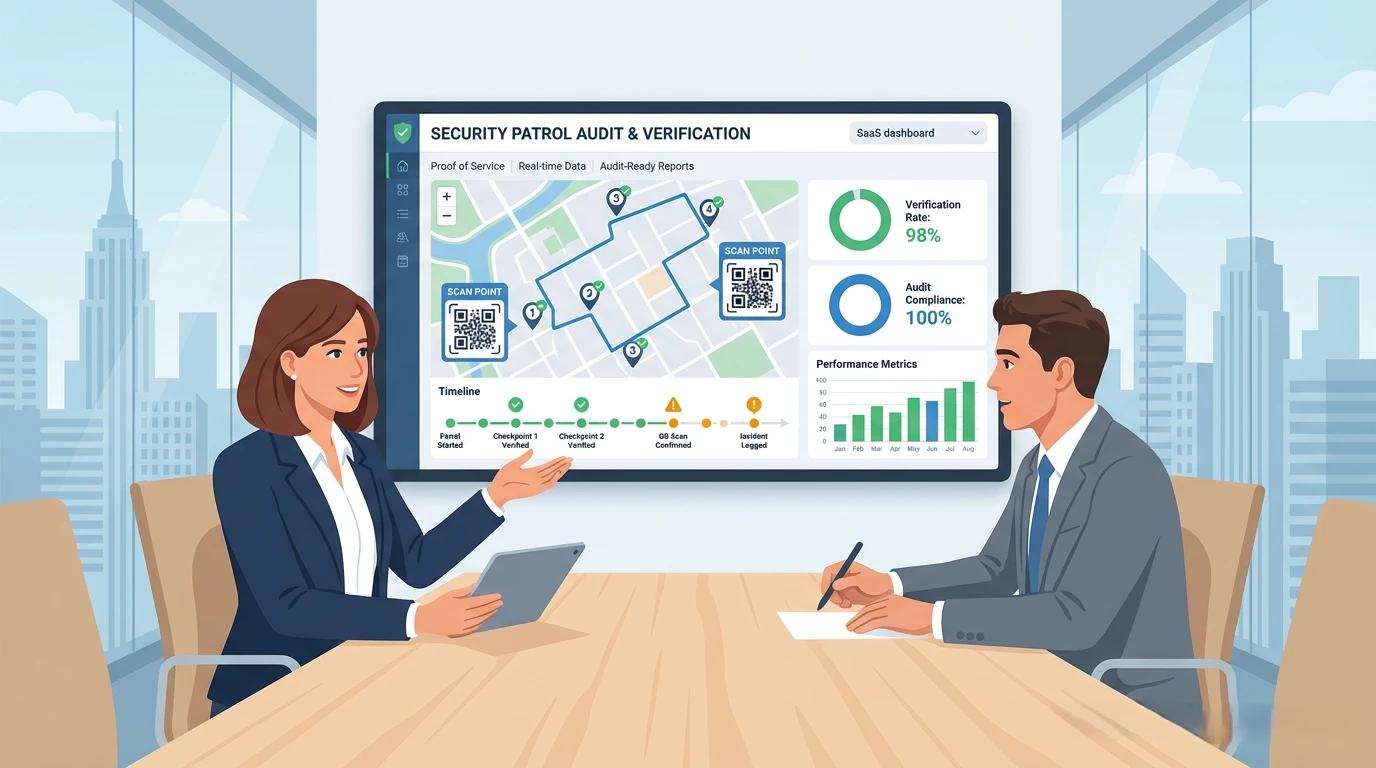
A modern guard tour system must go beyond logging and provide reconstructable patrol data.
- Patrol routes tied to real execution, not assumptions
- Checkpoints verified with context (QR + GPS where needed)
- Clear visibility into completed and missed activity
- Incident reports integrated into the same timeline
- Supervisor-level access to review everything in seconds
This is not just reporting — it is operational proof.
What leadership really buys
Leadership does not buy logs. Leadership buys clarity, accountability and defensible records.
Supervisors need fast review.
Managers need structured history.
Clients need visible proof.
A strong route history report closes the gap between field execution and management-level trust.
The business impact: contracts, not just compliance
Strong route history reports do more than pass audits. They directly support business outcomes.
Client complaint resolution
Resolve disputes faster with reconstructable patrol evidence instead of assumptions.
Service quality proof
Demonstrate performance with structured patrol data, not informal explanations.
Liability protection
Defend your operation with records that show what happened and when.
Pricing confidence
Justify your value when clients compare price against verifiable service delivery.
Contract renewal support
Renew with stronger confidence when your patrol history is reviewable and credible.
Operational trust
Turn route history into client-facing proof instead of internal-only paperwork.
In many cases, the difference between losing and keeping a contract is not the patrol itself — it is whether you can prove it clearly and instantly.
The new standard for security operations
In 2026, expectations have changed.
Route history reports are no longer internal tools — they are client-facing proof.
Security companies that rely on assumptions will struggle. Those that operate with verified, transparent patrol data will stand out — and grow.
What this means in practice
1
Patrol data must be structured enough to reconstruct the route, not just list events.
2
Checkpoint verification must include context, timing and operational visibility.
3
Incident records must be connected to the same timeline so the story stays complete.
4
Supervisors and clients need fast access to reviewable history, not delayed summaries.
5
The system must help you defend the service commercially, operationally and contractually.
Conclusion
If you cannot reconstruct a patrol from your current reports, it may be time to rethink your system.
Modern security operations require more than logs. They require structured history, visible accountability and audit-ready proof.
Route history is no longer a back-office detail. It is part of how security companies protect contracts, defend performance and build trust.
See what your patrol data actually shows
Start with a platform that delivers real patrol verification, structured history, and audit-ready visibility — from the field to the dashboard.
With Digital Guard Tour, you can move from unclear logs to reviewable operational proof that clients and supervisors can actually use.
Frequently Asked Questions
Why are route history reports so important during audits?
Because audits require more than general patrol claims. They require structured, reviewable evidence that shows what happened, when it happened and how the patrol unfolded.
How do route history reports help with client complaints?
They help you reconstruct the patrol quickly and answer with evidence instead of assumptions. This reduces disputes and shortens complaint resolution time.
What should a modern route history report include?
At minimum: patrol timeline, checkpoint-level verification, GPS-backed context where applicable, missed or delayed activity, and linked incident reports.
Can route history reports really affect contract renewals?
Yes. When clients can review clear, credible operational records over time, renewal decisions become easier because the service is supported by visible proof.
What is the difference between logs and operational proof?
Logs record events. Operational proof allows you to reconstruct the patrol with context, sequence, completed and missed activity, and reviewable incident history.