
ROI STRATEGY · SECURITY EXECUTIVES · GUARD TOUR SYSTEM
Guard Tour System ROI: How Security Companies Reduce Costs and Increase Profitability in 2026
Most ROI calculations in security are incomplete because they compare software price instead of operating performance. The real return appears when waste falls, supervision becomes lighter, and contracts become easier to protect and renew.
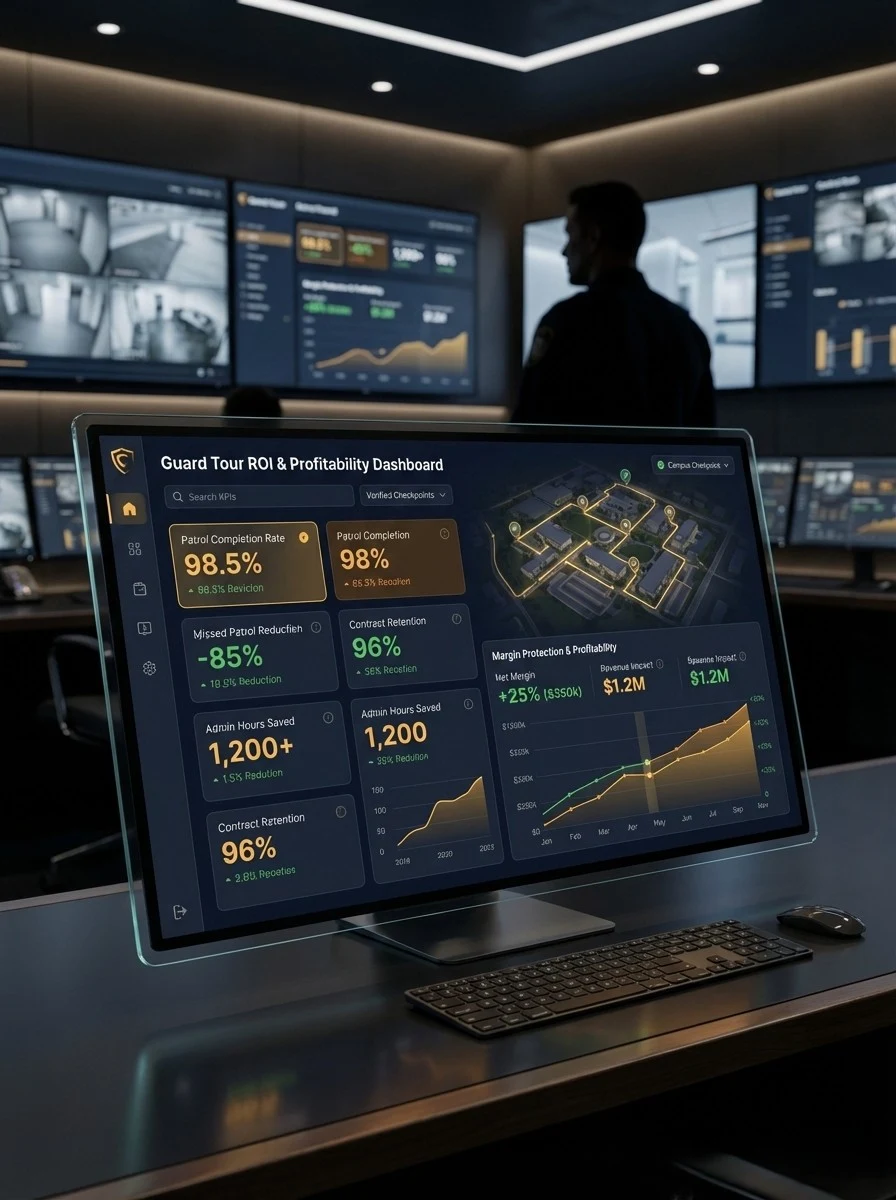
Software cost is visible. Operational waste is usually not.
- Cost saved from admin, supervision, and hardware friction
- Revenue gained from retention and pricing strength
- Margin protected through verifiable service delivery
- P&L logic instead of feature-level comparison
Where ROI actually appears on the P&L
ROI in security does not appear in a software dashboard first. It appears on the P&L.
Software cost is not the main cost driver in security operations.
Operational inefficiency is usually more expensive than software.
A guard tour system creates value by making work verifiable.
Real-time visibility reduces both risk and cost.
In practice, return appears in four places: lower admin cost, lower oversight cost, fewer commercial losses, and stronger renewal or pricing conversations.
Cost saved vs revenue gained
ROI Formula
ROI = Cost Saved + Revenue Gained – System Cost
Revenue Gained: better retention, stronger renewals, higher pricing confidence, and more defensible value during contract reviews.
Internal efficiency
Recovered admin hours, lower follow-up burden, less manual reconciliation.
Commercial strength
Better renewals, stronger positioning, and clearer service justification.
Lower contract leakage
Fewer disputes, fewer gaps in proof, fewer avoidable losses around service quality.
A modern guard tour system changes how security operations are evaluated at business level.
What usually destroys ROI first
Admin drag
Manual reporting, fragmented exports, and duplicated checking consume hours that do not create revenue.
Weak proof
If patrol work cannot be reconstructed clearly, client confidence and billing confidence both weaken.
Oversight load
Managers lose margin when they spend time chasing unclear events instead of running the operation.
Hardware friction
Dedicated devices create delay, replacement cost, and deployment friction before value is even generated.
How ROI improves when work becomes verifiable
A modern guard tour patrol system improves ROI by reducing the amount of labor that remains unclear, disputed, or manually reconstructed.
Real-time visibility
Managers spend less time reacting late because activity can be reviewed while operations are still active.
Verified execution
Work backed by GPS and QR-based confirmation is easier to defend internally and commercially.
Structured reporting
Clear data reduces rework, cuts admin handling time, and speeds up operational review.
Lighter oversight
When the system carries more of the proof burden, supervisors carry less of the verification burden.
Monthly savings scenarios
20–40 hours/month
Recovered from reporting friction, manual compilation, and repeated operational clarification.
10–20% fewer missed patrol issues
Better visibility reduces avoidable gaps in execution and reduces rework after the fact.
15–30% stronger retention potential
Service quality becomes easier to prove, discuss, and renew when records are transparent.
These are operational gains first. Software only enables them.
Margin protection examples
Fewer disputes
Clear proof lowers the chance that service value gets questioned after the shift is over.
Stronger renewals
Retaining a contract is often more profitable than chasing a new one with the same staff cost base.
Pricing confidence
Verifiable service gives commercial teams a stronger case when defending rates.
Manager time preserved
Less operational ambiguity means more time spent improving the business instead of decoding it.
Visibility is monetizable when it reduces friction around service value.
Legacy systems vs software-based ROI
| Factor | Legacy (RFID/NFC) | Modern software-based |
|---|---|---|
| Hardware burden | High | Low / none |
| Setup friction | Heavy | Light |
| Proof quality | Limited | Stronger |
| Admin burden | Higher | Lower |
| Visibility | Delayed | Real-time |
| Margin protection | Weaker | Stronger |
Why this matters commercially in 2026
Buyers increasingly care less about the reporting story and more about the business outcome.
They want fewer gaps, fewer surprises, clearer records, and more confidence that service quality can be defended when something goes wrong.
A modern guard tour system is therefore not just an operating tool. It becomes part of commercial positioning.
Atomic truth
A guard tour system does not improve ROI by being cheaper.
It improves ROI by removing waste.
Weak proof reduces both pricing power and renewal power.
Verification is financially valuable because it protects margin.
Conclusion
The wrong question is:
“What does the system cost?”
The better question is:
“What does the system save, protect, and help us keep?”
admin time
manager attention
client confidence
contract margin
If your system does not improve those outcomes, it is not generating strong ROI.
It is only adding software cost to an unchanged operation.
Evaluate ROI through margin protection, not just software cost
Explore a software-based system built to reduce waste, strengthen proof, and improve the economics of daily security operations.
- Commercial intent: helps buyers evaluate real ROI
- P&L framing: separates cost saved from revenue gained
- Reduced overlap: avoids repeating the main guide and pricing guide
- Trust building: explains ROI through profit logic, not hype
- Conversion-ready: supports product evaluation without acting like a landing page clone