
Operational Usability • Guard Tour Adoption
Why Overly Complex Guard Tour Systems Fail in Real-World Security Operations
In the security industry, systems rarely fail because they “lack features.” They fail because they try to do too much — and complexity breaks adoption where it matters most: in the field.

On paper, a highly complex guard tour system sounds impressive: payroll integrations, fleet modules, layered dashboards, configurable reporting engines, multi-tier admin controls.
In the field, however, security guards are not sitting behind desks. They are walking perimeters, working night shifts, and operating in rain, heat, or low-signal environments.
A guard tour platform is not an office productivity tool. It is an operational patrol system.
The Cost of Complexity
Outcome 1
Guards use the system incorrectly or inconsistently.
Small UI friction becomes non-compliance at scale.
Outcome 2
Companies invest in repeated retraining.
Training cost rises, performance still varies by shift.
Outcome 3
Management receives incomplete or unreliable patrol data.
Expensive software — reduced operational visibility.
Unlike many tech industries, private security includes a broad age and experience range. Many experienced guards are not digital-native users. They are trained in situational awareness, incident response, and physical security — not software navigation.
This matters.
A field-ready guard tour app must:
-
Require minimal onboarding time
-
Function clearly under stress
-
Operate smoothly on mid-range Android devices
-
Remain stable in low-connectivity environments
-
Minimize taps for core actions
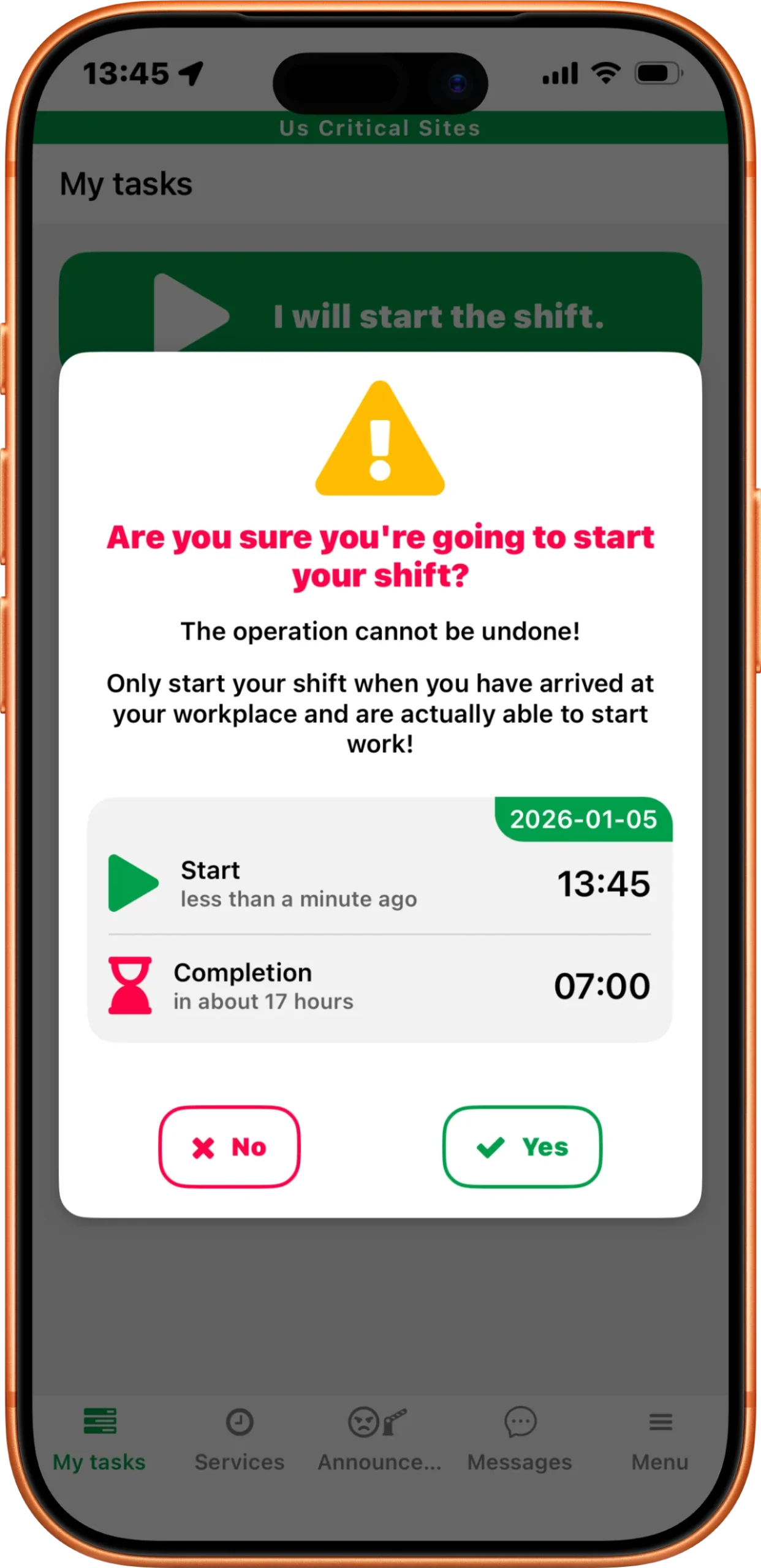
If starting a shift requires navigating multiple screens, adoption drops. If incident reporting is buried in menus, it gets delayed. If the interface overwhelms, compliance weakens.
In patrol operations, friction equals risk.
Complexity is not operational maturity. Clarity is.
1. Choosing based on feature lists instead of field testing.
A long specification sheet does not guarantee field compliance.
2. Making purchasing decisions without guard input.
Management signs contracts. Guards determine adoption.
3. Confusing administrative complexity with operational strength.
A patrol system’s primary role is to verify and document guard activity — not to replicate corporate ERP software.
Security technology should increase accountability — not introduce friction.
The goal of a guard tour system is simple:
Document patrol activity clearly. Provide defensible operational records. Reduce uncertainty in supervision.
A guard app succeeds when it disappears into the workflow.
If your team has to think about the software, the software is in the way.
Next step
Want to see how a truly simple, field-ready patrol system works in practice?
Try Trinity Guard® free — and see how usability drives adoption, compliance, and defensible patrol accountability.